Why Your Tai Chi Practice Changes When It Moves Indoors for the Winter
Quick Answer: Outdoor practice supplies uneven ground, open space, and environmental feedback - wind, temperature, birdsong - that your balance and attention systems have been using. Indoors, the floor is flat, the space is short, and the sensory field is empty, so the same form becomes easier physically and harder to concentrate in. Adjust the practice rather than expecting it to transfer unchanged.
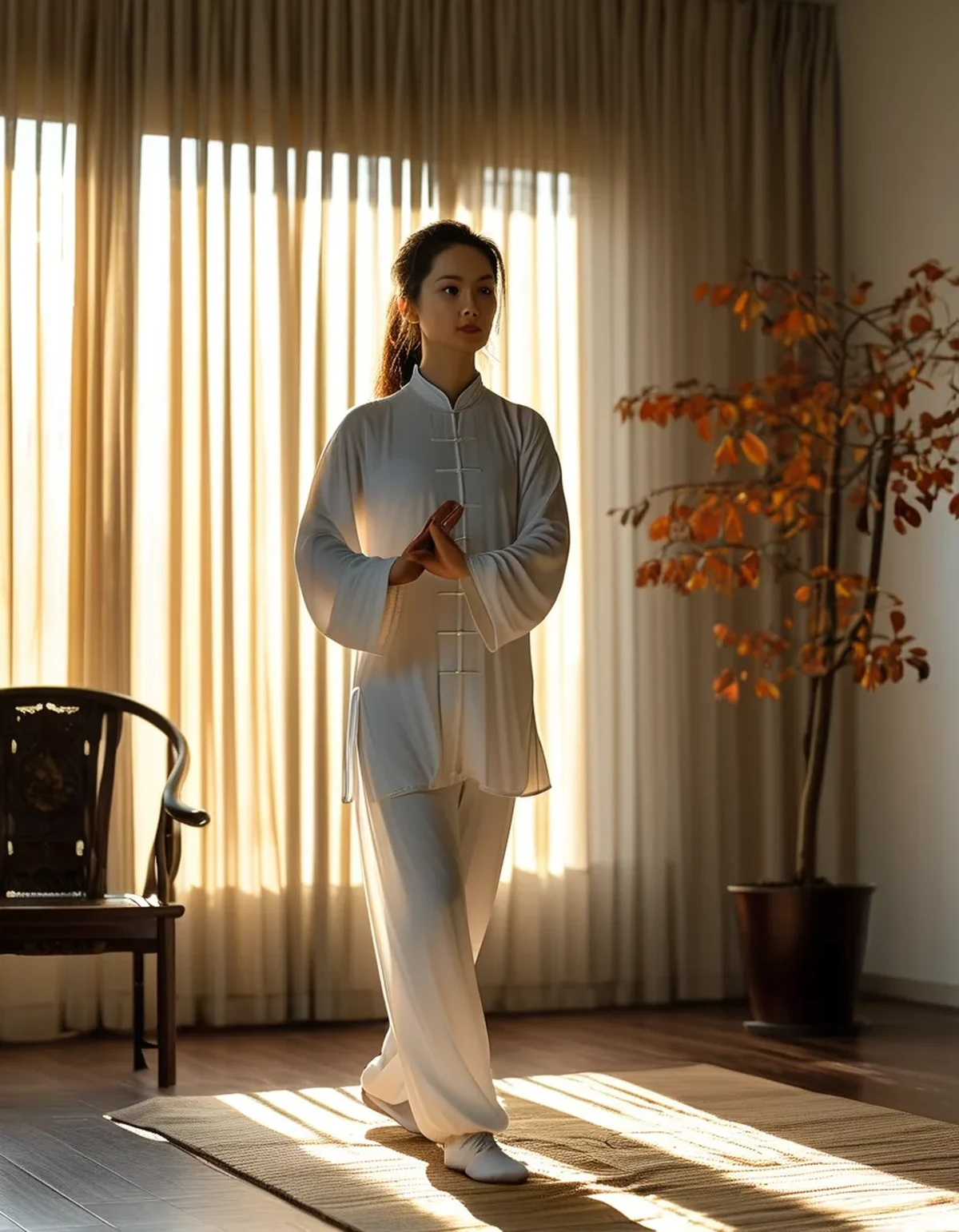
The park gets dark at six now, so you moved the form into the living room, and it has felt slightly wrong ever since.
Not wrong in a way you can name. The sequence is the same and you know it well. Something has gone out of it, and the usual conclusion - that you have lost focus, or that indoor practice is second-rate - is not what has happened.
What does the outdoor surface actually contribute?
Continuous small corrections that are doing more work than you realise.
Grass, packed earth, and gravel are all slightly uneven. Every weight shift lands on a surface that is a fraction different from the last one, so your ankle, foot, and hip make constant micro-adjustments. That is a large part of why outdoor practice produces the balance benefits tai chi is known for.
A flat wooden floor removes all of it. The same form performed identically asks far less of your stabilising system, which is why an indoor session can leave you feeling like nothing much happened.
Footwear compounds it. Outdoors most people practise in shoes; indoors most practise barefoot or in socks. Barefoot is generally better for foot sensation and worse for the sliding that a smooth floor invites, and slippery socks on laminate are the single most common cause of indoor tai chi injuries.
The practical response is not to make the floor uneven. It is to introduce the challenge deliberately: slower weight transfers, longer holds in the transitional positions, and occasional practice with the eyes closed for short passages, which restores much of the balance demand the ground used to provide.
Why does the space itself change the form?
Because most forms were designed to travel, and a living room does not let them.
A long form covers real ground. Practising it in a space where you have to shorten every step or turn early changes the movement in ways that become habits within a few weeks. Shortened stances, cut-off transitions, and a slightly hurried quality all creep in, and they persist when you go back outdoors in spring.
There is also a psychological effect. Practising with a wall two feet from your extended hand produces a subtle guarding that shows in the shoulders. People compress their arm movements indoors without ever deciding to.
The other loss is visual depth. Outdoors your gaze can rest on something distant, which relaxes the eyes and, through them, the neck and shoulders. Indoors your focal distance is a few feet, and the eyes stay in near-focus for the whole session. This is a real contributor to the tightness people report in winter practice, and it explains why practising facing a window helps more than it seems it should.
Where a full form does not fit, the honest answer is to practise sections rather than a compressed whole. A quarter of the form done at full size is better practice than all of it done small.

Myth vs Fact: Indoor Tai Chi
Myth: Indoor practice is a compromise you tolerate until spring. Fact: It offers things outdoor practice cannot - no wind, no distraction, no self-consciousness, and the ability to slow down radically. Many people do their most detailed technical work in winter for exactly these reasons.
Myth: You need a large room. Fact: You need enough space for one full stance in each direction, which is less than people assume. What you need more than area is a plan for how to practise a travelling form in a fixed space.
Myth: Socks are fine on a wooden floor. Fact: Socks slide, and sliding during a weight transfer is how people hurt a knee. Bare feet or a thin flat shoe with some grip is the right choice, and a thin rug or mat is worth having if the floor is polished.
Myth: Practising in a warm room is better. Fact: A slightly cool room is better for tai chi than a warm one - it keeps you alert and it discourages the sluggishness that indoor winter practice tends toward. Warm enough not to be tense, cool enough not to be drowsy.
Myth: The form is the practice. Fact: Standing practice, weight-shifting drills, and single-movement repetition are all more space-efficient than the form and arguably more valuable. Winter is when many practitioners get the most out of these, because there is no room to do anything else.
How should you restructure the indoor season?
Treat it as a different phase with its own aims rather than a smaller version of summer.
Pick the space deliberately, once. Enough room for a full stance in four directions, a non-slip surface, and if possible a window to look through. Practising in the same spot every day is worth a surprising amount, because your body learns the space and stops navigating it.
Slow down more than feels necessary. Indoors you can practise at a genuinely slow tempo without feeling watched, and slow tempo is where the postural detail lives. A form done at half speed indoors is a different and often better session than the same form at normal speed in a park.
Add standing practice. Ten minutes of standing takes no space at all and addresses exactly what the flat floor removed. It is also the practice most people abandon in summer because it is less enjoyable outdoors.
Work in sections at full size rather than the whole form compressed. Rotate which section you focus on week to week.
Introduce deliberate instability. Short passages with eyes closed, slower weight transfers, and longer holds at the point of transition where the balance demand is highest.
Practise facing different directions. A form learned facing one way in a fixed room becomes surprisingly dependent on the visual cues in that direction. Turning ninety degrees every few sessions keeps the form portable, which matters when you take it back outdoors in April.
And keep some outdoor practice going. Even one short session a week outdoors through the winter maintains the ground-feel and the spatial sense, and it makes the spring transition trivial rather than jarring.
FAQ: Indoor Tai Chi Questions, Answered
How much space do I genuinely need?
Enough to take a full stance forward and to each side without adjusting - for most people around six by eight feet. Less than that and section practice is the better approach rather than trying to fit the whole form in.
Is practising on carpet a problem?
Carpet is grippier than wood, which can be hard on the knees during turning movements, since the foot cannot pivot. A thin flat shoe or a small pivot mat under the turning foot solves it. Deep pile carpet also removes ground feedback almost entirely.
Should I keep going to class or practise at home?
Both, and the balance shifts in winter. Class provides the correction that home practice cannot, and home practice provides the volume. If you have to choose in a short-daylight season, keep the class and practise sections at home rather than the reverse.
TL;DR:
- Uneven outdoor ground supplies constant balance corrections that a flat floor removes entirely.
- Short indoor spaces shrink stances and cut transitions, and those habits persist into spring.
- Near-focus vision indoors contributes to the neck and shoulder tightness people blame on winter.
- Slow down, practise sections at full size, add standing practice and eyes-closed passages, and keep one outdoor session a week.
Indoor practice is not a lesser version of what you were doing in the park. It is a different set of conditions, and the form only feels flat while you are still practising it as though nothing changed.
Keep Reading
This article is for general informational purposes only and is not medical advice. Always consult a qualified health professional for guidance specific to you.