Why Tai Chi in Shoes Feels Different From Barefoot and Which to Choose
Quick Answer: Barefoot gives you maximum sensory feedback from the sole, which is what weight-shift precision depends on — the core skill in tai chi. Shoes add warmth, protection and grip on unhelpful surfaces, at the cost of some of that feedback. The practical answer for most people is barefoot or thin flat shoes indoors on a stable surface, and thin flexible shoes outdoors, avoiding anything with a raised heel or thick cushioning.
The question sounds like a preference. It is not.
What is under your feet determines what your feet can tell you, and tai chi runs almost entirely on that information.
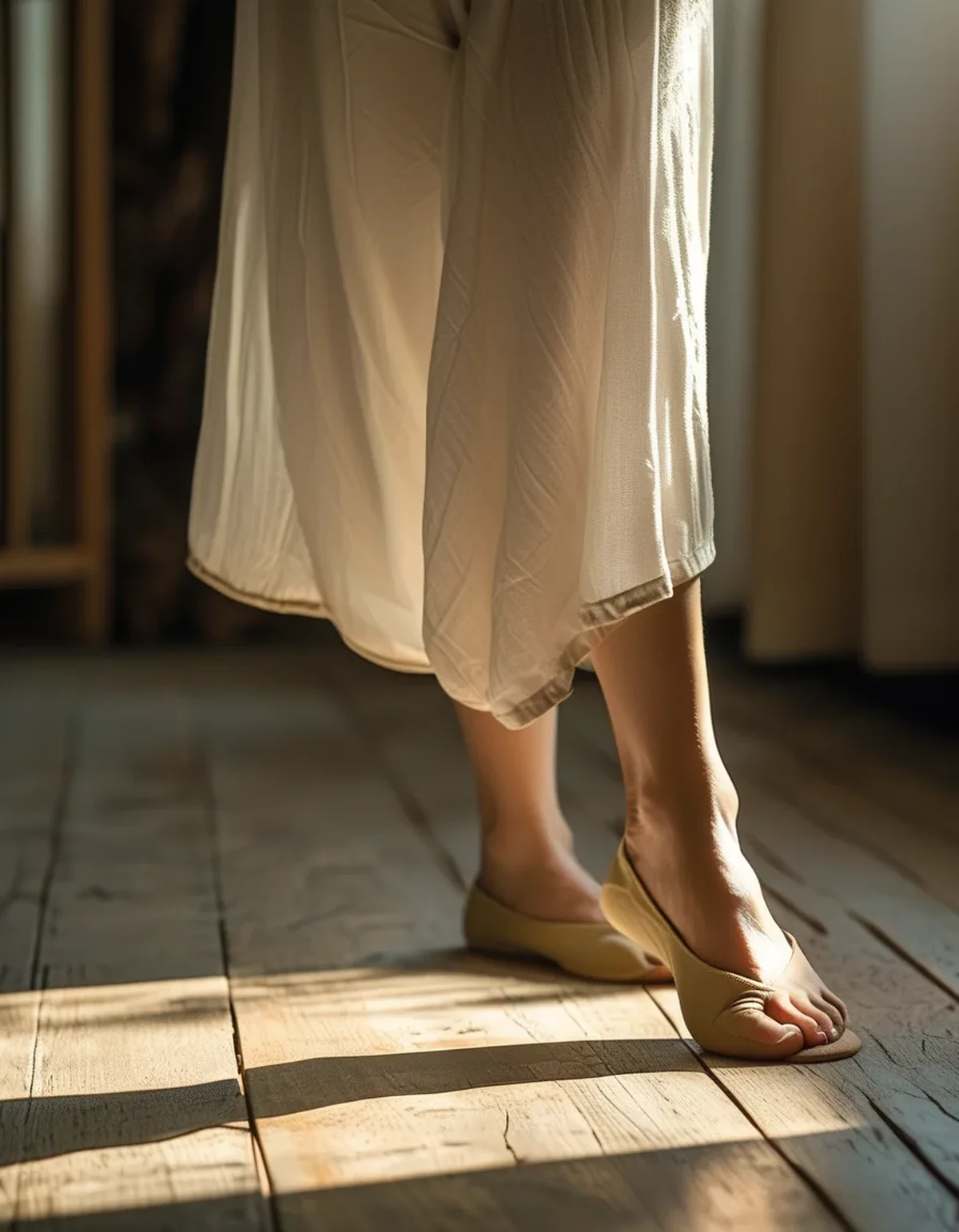
Why does foot sensation matter so much in tai chi?
Because the entire method is built on knowing exactly where your weight is, and that knowledge comes from the sole.
The sole of the foot is densely supplied with mechanoreceptors — pressure sensors that report load distribution continuously. When you shift from 70% on the back leg to 70% on the front, the primary way you know the shift happened correctly is that the pressure pattern under your feet changed in a particular way.
Tai chi asks for precision in this that few other activities require. Not just which foot, but where on the foot: heel, ball, outside edge, the point at which the weight passes through. Teachers spend a great deal of time on this because it is the mechanism through which the whole form generates stability.
A thick, cushioned sole blurs the signal. Foam compresses under pressure and distributes it, which is precisely the point of cushioning and precisely the wrong property here. You feel that you are on your front foot; you do not feel the gradient of how you got there.
A raised heel is worse, and it is structural rather than sensory. Any heel drop shifts your weight forwards, changes your ankle angle and alters the alignment through the knee — which is exactly the alignment tai chi stances are built around. This is why an ordinary running shoe, with 8-10mm of drop and substantial cushioning, is among the worst possible choices despite being the most comfortable shoe most people own.
When are shoes actually the better choice?
More often than the barefoot argument suggests, and mostly for reasons of surface and temperature.
Cold floors. Cold feet lose sensitivity, which defeats the entire benefit of being barefoot. A cold concrete or tiled surface in autumn will numb your soles within ten minutes, at which point thin shoes give you more information than bare skin does.
Outdoor practice on any uneven ground. Grass, gravel, park paths — protection matters, and the distraction of watching where you step costs more than the sensory loss.
Grippy floors that are too grippy. This surprises people. Tai chi involves pivoting on the ball or heel of the foot, and a rubber mat or a high-grip surface can catch the foot mid-turn. That is a genuine knee risk — the foot stays and the femur rotates. On a sticky surface, a smooth-soled shoe is safer than bare skin.
Public spaces where bare feet are impractical, which covers most community halls and outdoor classes.
And any foot condition that warrants it. General information, not medical advice — but neuropathy, plantar fasciitis, diabetes-related foot risk and healing injuries all change this calculation, and in some of those cases barefoot practice is specifically inadvisable. A podiatrist’s view is worth more than a general rule.
Myth vs Fact: Tai Chi Footwear
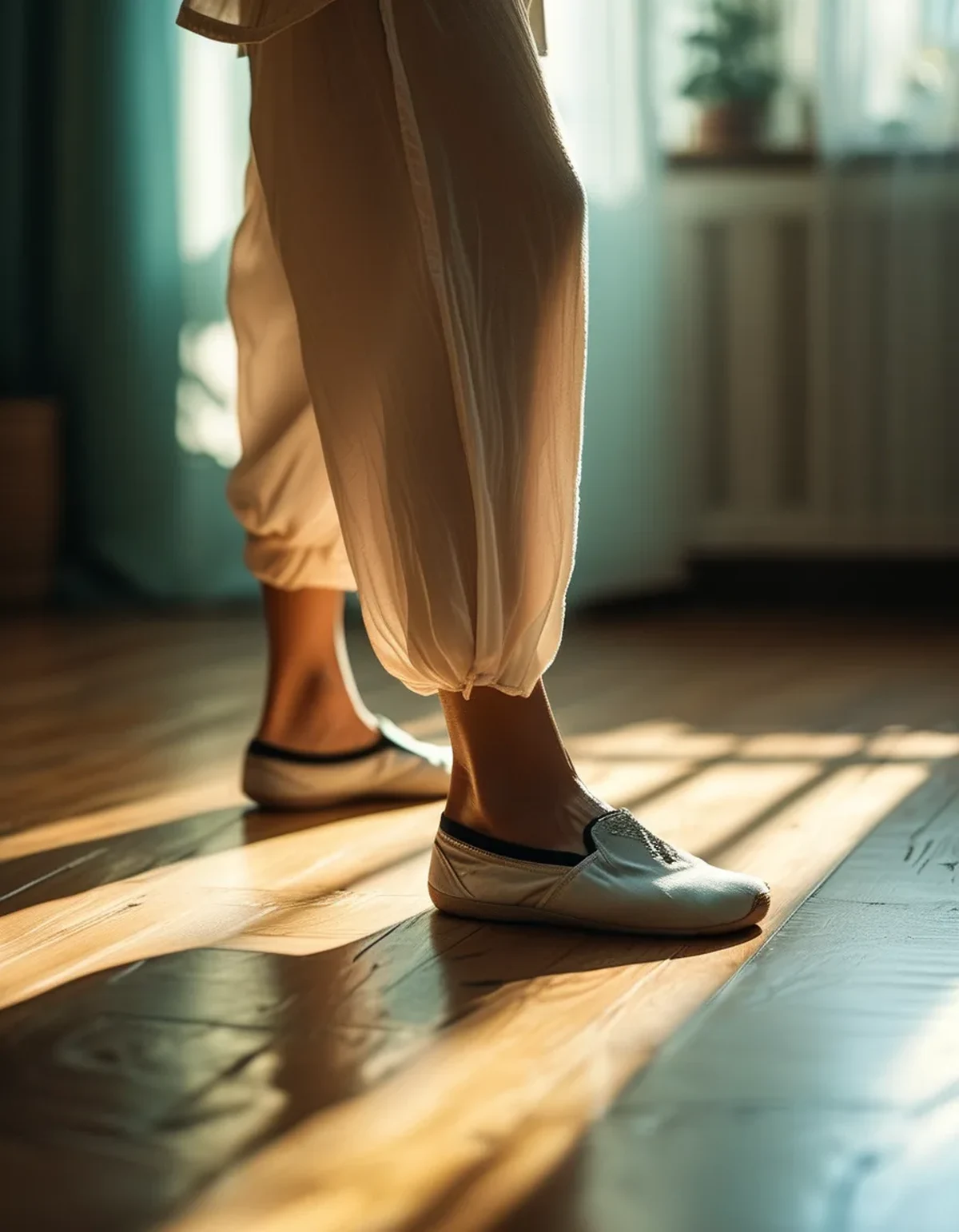
Myth: traditional tai chi shoes are just an aesthetic. Fact: the classic thin-soled cotton or canvas slipper is a functional design — flat, flexible, minimal, with a sole that grips enough to be safe and slides enough to pivot. It is essentially a barefoot-plus-protection solution, and it remains among the best options available for a small amount of money.
Myth: barefoot is always more authentic. Fact: historically, practice was in shoes far more often than not. The barefoot emphasis is largely a modern studio convention borrowed from yoga. Both are legitimate; the choice is practical.
Myth: cushioning protects your knees. Fact: in tai chi, knee protection comes from alignment — knee tracking over the foot, not passing beyond the toes, and the pelvis positioned correctly. Cushioning does nothing for any of these, and by degrading feedback it can make the alignment errors harder to notice.
Myth: grip is always good. Fact: pivoting is a core movement, and excessive grip converts a pivot into a twisting force through the knee. This is one of the more common causes of tai chi knee complaints, and it is much more often a surface-and-footwear issue than a technique one.
Myth: socks are a reasonable compromise indoors. Fact: socks are the worst option on most floors — they reduce sensation like a shoe and eliminate grip entirely, which is a fall risk during weight transfer. Grip socks with individual sole pads are a genuine compromise; ordinary socks are not.
Myth: you should pick one and stick with it. Fact: practising in both conditions is useful, because your balance system learns to rely on the inputs available rather than becoming dependent on one. Just do not change footwear in the middle of learning a new movement.
How should this change with the seasons?
Meaningfully, and it is worth adjusting deliberately rather than persisting with a summer setup into November.
As floors get colder, move to thin shoes indoors. The threshold is simple: if your feet feel cold ten minutes in, you have lost more sensation to temperature than you would have lost to a thin sole.
Outdoors, autumn brings the specific problem of wet leaves and damp grass, both of which are considerably more slippery than they look and are a real hazard during weight-shift practice. A shoe with modest tread is appropriate; a smooth-soled slipper is not.
Watch for the surface change nobody plans for. Practice moves indoors as the weather turns, and an indoor floor is usually harder and grippier than the grass you were on in August. That combination — harder underfoot, more grip during pivots — is why knee and ankle niggles often appear in the first few weeks after moving inside, and why it is worth deliberately reducing stance depth for a couple of weeks after the change.
Warm your feet before practising in cold months. Two minutes of ankle circles, toe spreading and rolling a ball under the arch restores a surprising amount of sensitivity, and it is the cheapest improvement available to a cold-weather practice.
And take shoes off for part of the session where you safely can. Even ten minutes of barefoot standing practice or slow weight-shift drills preserves the sensory skill through a winter of shod practice, which is what makes spring feel like a continuation rather than a restart.
FAQ: Tai Chi Footwear, Answered
What should I look for if I am buying shoes for this?
Flat — zero or near-zero heel drop. Thin and flexible enough to roll up. Wide enough at the toes that they can spread. A sole with moderate grip rather than maximum grip. Traditional tai chi slippers, minimalist barefoot-style shoes and thin canvas plimsolls all qualify. Running shoes, cross-trainers and anything with an arch support structure do not.
My feet ache when I practise barefoot. Is that normal?
Common early on, and usually a sign that the small muscles of the foot are working in a way they do not in cushioned shoes. Build up gradually rather than switching entirely. If the ache is sharp, localised, or worse in the morning, that is worth having looked at rather than training through.
Does the surface matter as much as the shoe?
More, arguably. A sprung wooden floor is the ideal — enough give to be comfortable, enough consistency to feel precisely. Concrete is hard and cold, thick carpet is unstable and blurs feedback, and a rubber gym mat grips too well for safe pivoting. If you can choose the surface, that choice will do more for your practice than the footwear decision will.
TL;DR:
- Tai chi runs on sole feedback, because weight-shift precision is the core skill and pressure sensors in the foot are how you monitor it.
- Cushioning blurs that signal and a raised heel changes the alignment the stances depend on — so ordinary trainers are the worst common choice.
- Shoes win on cold floors, uneven outdoor ground, over-grippy surfaces where pivoting is a knee risk, and public spaces.
- Look for flat, thin, flexible and wide, with moderate rather than maximum grip; avoid ordinary socks entirely.
- Adjust seasonally, reduce stance depth for a fortnight after moving indoors, and keep some barefoot practice through winter.
The useful reframe is that footwear in tai chi is part of the equipment of the practice rather than a comfort choice made before it starts. Getting it right does not make your form better on its own — it just stops the floor from hiding the information your form is built on.
Keep Reading
This article is for general informational purposes only and is not medical advice. Always consult a qualified health professional for guidance specific to you.