Why Tai Chi Feels Harder When You Slow It Down
Quick Answer: Moving slowly removes momentum, which normally does a large share of the work of carrying you through a movement. Without it, your muscles must control every degree of the range under continuous tension, and your balance system gets no help from forward motion. Slower movement means more time under tension, more balance demand and more exposed error — which is precisely why it is trained.
Your teacher says to go slower.
You go slower, and within a minute your legs are burning and you are wobbling in a posture you held perfectly well last week.
That is the practice working, not the practice failing.
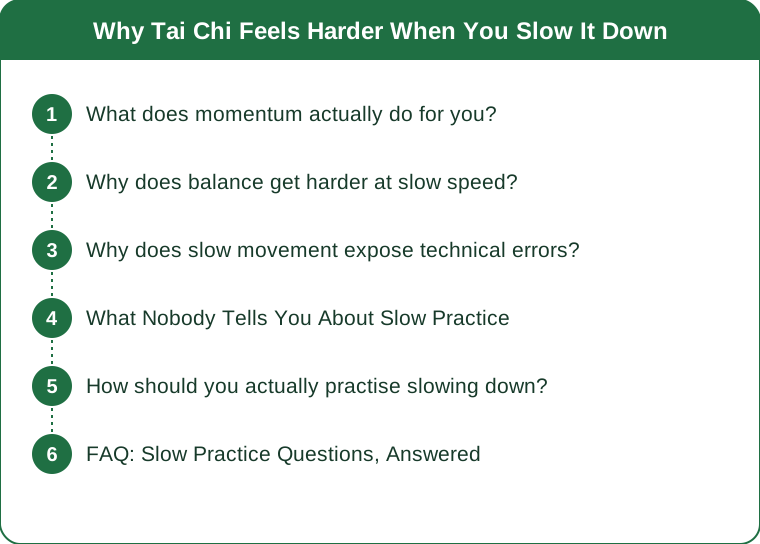
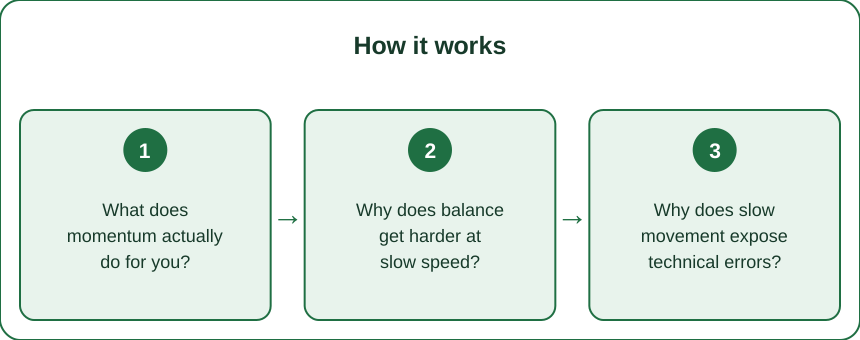
What does momentum actually do for you?
Far more than most people realise, and slowing down is how you find out.
When you move at normal speed, you accelerate a limb and then largely coast. That coasting phase is momentum doing the work — your muscles are producing much less force than the movement suggests, because a body already in motion tends to stay in motion.
Move at a quarter of that speed and there is almost no momentum to borrow. Every position along the way must be actively held and actively passed through. In practical terms, a slow weight shift from one leg to the other might involve twenty seconds of continuous single-leg loading, where a normal-speed version involves perhaps two.
This is the same principle behind slow tempo work in strength training, where lifting a weight over four seconds is substantially harder than lifting it over one. Time under tension is the variable, and tai chi manipulates it deliberately.
Why does balance get harder at slow speed?
Because forward motion is itself a stabilising force, and slow movement removes it.
Walking is often described as a series of controlled falls — you are stable partly because you keep moving into the next step. Riding a bicycle is the clearest example of the principle: it is far easier at speed than at walking pace.
When you move slowly, your balance system cannot rely on momentum to carry you through the unstable middle of a transition. You have to hold the unstable position, sometimes for several seconds, using continuous small corrections from your ankles, hips and trunk.
That is genuinely demanding, and it is also the exact quality that makes tai chi one of the better-studied forms of exercise for balance and fall prevention in older adults. The training effect is not incidental to the slowness. It is the slowness.
Why does slow movement expose technical errors?
Because errors that momentum hides become impossible to hide.
At normal speed, a slightly misaligned knee, a weight shift that happens a fraction too early, or a hip that never quite rotates are all carried through by the flow of the movement. You arrive at the destination and the movement looks acceptable.
Slow it down and every one of those appears as an actual physical problem — a wobble, a lurch, a moment where you cannot continue without a small correction. This is why teachers slow students down when correcting form. It is a diagnostic tool as much as a training method.
The corollary is worth stating plainly: if a movement falls apart when you halve the speed, it was already flawed at full speed. You simply could not see it. The slow version is the honest one.
What Nobody Tells You About Slow Practice
Your legs will complain before your patience does. New practitioners often expect a mental challenge and get a quadriceps and glute challenge. Sustained slow weight shifts are genuine strength work, and beginners are frequently sore after their first serious slow session.
Breathing is the thing that usually breaks first. Slow movement tempts people to hold their breath during the hardest part of a transition. A steady, unhurried breath is part of the technique, not an accompaniment to it.
Slower is not always better. There is a point past which slowness becomes stiffness and the movement loses its continuity. The target is continuous, unhurried movement without pauses, not the slowest possible motion.
The hardest part is usually the transition, not the posture. Most people can hold a named posture. What exposes them is the twenty percent of the movement between two postures, where the weight is genuinely in transit.
It is a strength method with a reputation as a gentle one. Tai chi is often recommended as low intensity, which is true for joint impact and false for muscular demand in the legs. A long form practised properly is meaningful lower body work.
How should you actually practise slowing down?
Progressively, and on a small piece of the form rather than the whole thing.
Pick one transition. Take a single weight shift or a single step and practise only that, at a speed where you can maintain control throughout. Ten repetitions.
Halve the speed once you can do it cleanly. If the movement degrades, you have found your current limit — practise at the speed just above it rather than pushing into the wobble.
Add the breath. Once the movement is stable, match a full inhale or exhale to the transition. If you run out of breath before the movement finishes, the movement is too slow for your current breathing, not the other way around.
Build tolerance separately. If your legs are the limiting factor — which for most beginners they are — a few sets of slow, controlled split squats or step-downs twice a week will build the capacity faster than form practice alone.
Expect four to six weeks before slow practice starts feeling sustainable rather than punishing. That is a normal timeline for the strength and balance components to catch up.
This is general information and not medical advice. If you have a knee, hip or balance condition, work with a qualified instructor who can adapt the stance depth for you.
FAQ: Slow Practice Questions, Answered
How slow should a form actually be?
A common guideline for a short form is around five to six minutes, and longer forms considerably more. But the honest answer is: slow enough that you never rely on momentum, and no slower.
Is faster tai chi less valuable?
No — many traditional styles include faster sections, and speed changes are part of the art. But for building the balance and control qualities most people practise tai chi for, the slow work is where the adaptation happens.
Why do my knees ache during slow practice?
Usually stance depth or knee alignment rather than the slowness itself. Raise the stance, keep the knee tracking over the middle of the foot, and reduce depth until it is comfortable. Persistent knee pain should be assessed by a professional.
TL;DR:
- Slow movement removes momentum, so your muscles must control the entire range under continuous tension.
- Balance is harder at low speed because forward motion is itself stabilising — the same reason cycling slowly is hard.
- Slowness exposes technical errors that speed hides, which makes it a diagnostic tool as much as a training method.
- Progress on one transition at a time, add the breath second, and expect four to six weeks for your legs to catch up.
The slowness is not a stylistic decision that happens to look peaceful. It is the load.
Keep Reading
This article is for general informational purposes only and is not medical advice. Always consult a qualified health professional for guidance specific to you.