Why Tai Chi Works for Balance When Balance Exercises Don't
Quick Answer: Most falls occur during weight transfer — stepping, turning, changing direction — not while standing still. Tai chi trains continuous, controlled weight shifting through a large range with constant postural adjustment, which is precisely the skill involved. Reviews of fall-prevention research have consistently found tai chi among the more effective interventions for reducing fall risk in older adults.
You can stand on one leg for thirty seconds. You still feel unsteady turning around in the kitchen. Those are different skills, and only one of them has been trained.
Why is tai chi effective for balance specifically?
Because of what it trains, not how gentle it is.
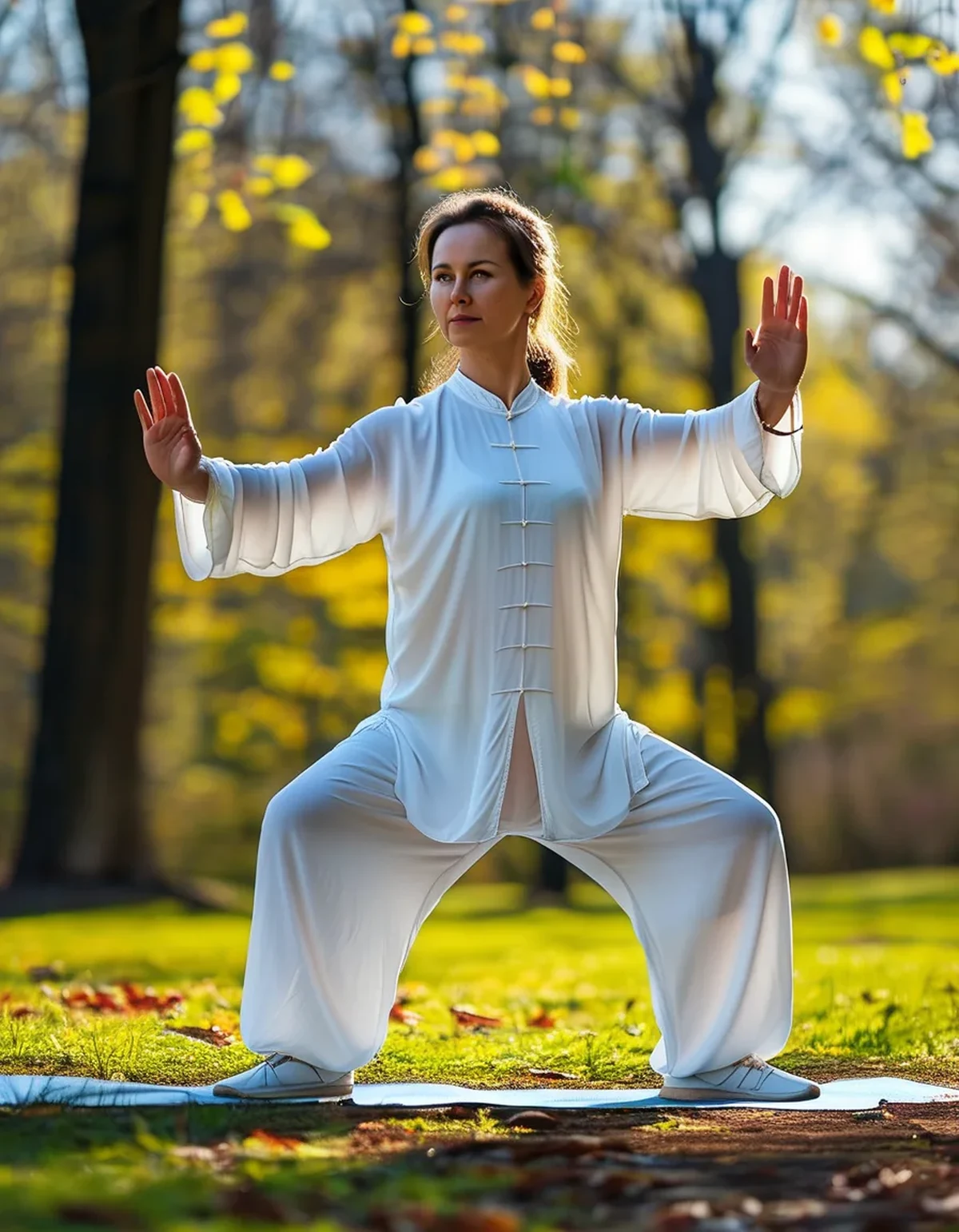
It trains transitions, not positions. Nearly every movement in a tai chi form involves shifting weight from one leg to the other while maintaining an upright, controlled posture. That transition — the moment when weight is between two bases of support — is where instability lives and where falls occur.
It trains slowly, which is harder. Moving slowly removes momentum. Momentum masks balance deficits; without it, the stabilizers have to work continuously. This is why slow movement feels disproportionately demanding.
It trains in multiple directions. Forward, backward, and rotational weight shifts, with turning. Most balance exercises are static and single-plane. Real life is not.
It includes a cognitive component. Remembering a sequence while moving is dual-tasking, and dual-task balance — walking while thinking or talking — is where many real-world falls happen.
And it’s continuous. A form is 5 to 20 minutes of uninterrupted controlled movement. That’s sustained postural control practice, not 30 seconds of it.
The research base here is unusually solid for a movement practice. Multiple systematic reviews have found meaningful reductions in fall rates among older adults practicing tai chi, with effect sizes comparable to or better than other exercise interventions.
What does the evidence actually show?
More than for most alternative movement practices, and it’s worth being specific.
Falls and balance: systematic reviews of randomized trials have found tai chi reduces fall rates and fall risk in older adults. It appears in fall-prevention guidance from major health organizations for this reason.
Blood pressure: meta-analyses have found modest reductions in both systolic and diastolic blood pressure. The effect is real but moderate — comparable to other light-to-moderate exercise, not a replacement for treatment.
Pain and function in knee osteoarthritis: evidence supports improvements in pain and physical function, and tai chi appears in some clinical guidance for this population.
Psychological outcomes: consistent findings of reduced anxiety and depressive symptoms, though study quality varies and the mechanism likely overlaps with general exercise plus a mindfulness component.
Where evidence is weaker: claims about specific organ function, energy flow, or disease treatment. The mechanisms that hold up under study are the mechanical and neurological ones — postural control, proprioception, and lower-body strength.
What to make of that: tai chi is a well-supported intervention for balance, function, and general wellbeing, and it doesn’t need the stronger claims to be worth doing.
This is general information, not medical advice.
Myth vs Fact: Tai Chi
Myth: It’s only for older adults. Fact: The balance and mobility benefits apply at any age, and it’s used by athletes for proprioceptive training. The demographic skew reflects marketing rather than suitability.
Myth: It’s not real exercise. Fact: Sustained slow movement in a partial squat is genuinely demanding on the quadriceps and hip stabilizers. Most beginners’ legs are tired after 20 minutes. It’s classified as light-to-moderate intensity, which is a meaningful stimulus for many populations.
Myth: You need to learn a long form to benefit. Fact: Simplified forms of 8 to 24 movements deliver the balance benefits, and most research uses shortened forms. The 108-movement traditional forms are a depth pursuit, not a requirement.
Myth: It’s a martial art you can’t use. Fact: Tai chi is a martial art with genuine applications, but the health practice and the combat practice have diverged substantially. Most classes teach the health version and that’s what the research studied.
Myth: Any slow movement counts. Fact: The specific elements that matter are the controlled weight transfer, the maintained posture, and the continuous flow. Slow movement without weight shifting doesn’t train the same thing.
Myth: You have to practice daily for it to work. Fact: Study protocols commonly use two to three sessions per week, and that’s enough to produce measurable balance improvements.
How do you start without a class nearby?
The barrier is usually access, and there are workable paths.
Start with weight-shifting practice, which is the core skill and needs no form knowledge:
- Stand with feet shoulder-width apart, knees soft.
- Slowly shift all weight to the right leg over 5 seconds. Hold 3 seconds.
- Slowly shift to the left over 5 seconds. Hold.
- 10 repetitions each side.
That single drill contains the essential mechanism. Do it near a counter for safety.
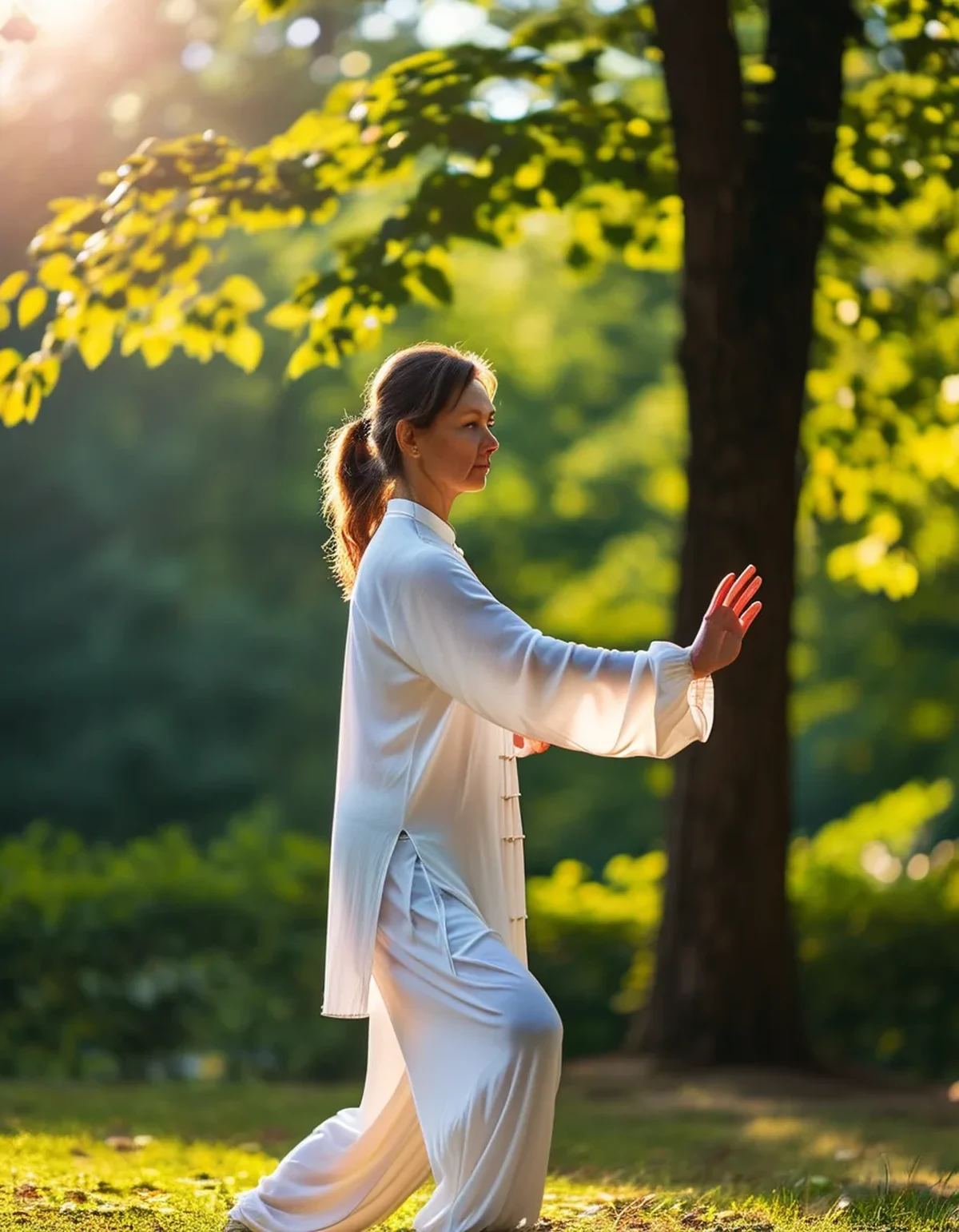
Then add stepping: shift weight fully to one leg, step the other foot forward slowly and place it without weight, then transfer. This is the fundamental tai chi step and it’s trainable on its own.
Then learn a short form. The Yang-style 8-form or 24-form are the most commonly taught and the most widely documented. Video instruction is imperfect but functional for these.
What to prioritize when self-teaching:
- Keep the knee tracking over the foot, never collapsing inward
- Don’t let the knee travel past the toes in a deep stance
- Stay upright — the spine stays vertical, the movement comes from the legs and waist
- Breathe continuously and naturally; don’t hold
Practice near support for the first weeks. The point is to train balance safely, not to test it.
What should you expect in the first few months?
A different progression than most exercise.
Weeks 1 to 3: Legs get tired quickly and the sequence is hard to remember. Both are normal and both resolve. The cognitive load of remembering the form is significant at first and it drops away.
Weeks 4 to 8: Movements start connecting. Balance improvements begin to be noticeable in daily life — turning, reaching, stepping onto uneven ground feels different.
Months 3 to 6: The form becomes automatic enough that attention shifts to quality. This is where most people report the biggest subjective change, both in balance and in the calming effect.
Beyond that: refinement, longer forms, or deeper study of principles. Or just continuing, which is what most people do.
Practical guidance: 20 to 30 minutes, two or three times a week, is the dose used in most research showing benefit. Daily short practice works too. Consistency matters far more than duration.
Who should check with a professional first: anyone with significant balance impairment, recent falls, joint replacement, or cardiovascular conditions. Not because tai chi is risky — it’s one of the lower-risk options available — but because appropriate modification matters and a supervised class is safer than self-teaching for those groups.
This is general information, not medical advice. Consult a healthcare professional before starting a new exercise program, particularly with existing balance or joint concerns.
FAQ: Tai Chi Questions, Answered
How is tai chi different from qigong?
Qigong is generally simpler, often involving repeated individual movements rather than a continuous sequence, with more emphasis on breath. Tai chi is a martial art with a defined form. They overlap considerably and many classes teach both; for balance training specifically, tai chi’s continuous weight transfer does more.
Do I need special clothing or shoes?
Loose comfortable clothing and flat, flexible shoes — or bare feet on a safe surface. Cushioned running shoes are actively unhelpful, since the soft compressible sole reduces the ground feedback that balance training depends on.
Can I do it with knee problems?
Often yes, with modification — higher stances, shorter steps, less depth. Tai chi appears in some clinical guidance for knee osteoarthritis specifically. But get an individual assessment first, and tell the instructor before the first class rather than after.
TL;DR:
- Falls happen during weight transfer, and tai chi trains exactly that — slowly, in all directions, continuously.
- Evidence is strongest for fall reduction, balance, blood pressure, and knee osteoarthritis function.
- Short forms (8 or 24 movements) deliver the benefits; long forms are optional depth.
- Two or three 20–30 minute sessions a week is the dose used in most research.
If you can hold a one-leg stand but feel unsteady turning in the kitchen, you’ve trained the position and not the transition. That’s the gap tai chi is unusually good at closing.
Keep Reading
This article is for general informational purposes only and is not medical advice. Always consult a qualified health professional for guidance specific to you.