Why Tai Chi Outdoors Feels Different From the Same Form Indoors
Quick Answer: Balance uses three inputs — vision, inner ear and proprioception. Indoors, a still room and a flat floor make vision and proprioception easy, so you lean on them. Outdoors, the ground is uneven and the visual field moves, so your system has to reweight in real time. That is harder and it is also the training effect: outdoor practice builds balance that transfers to real life in a way studio practice does not.
Indoors, the form flows.
Outdoors, the same form feels like you have never done it.
Nothing has gone backwards — the problem just got more honest.
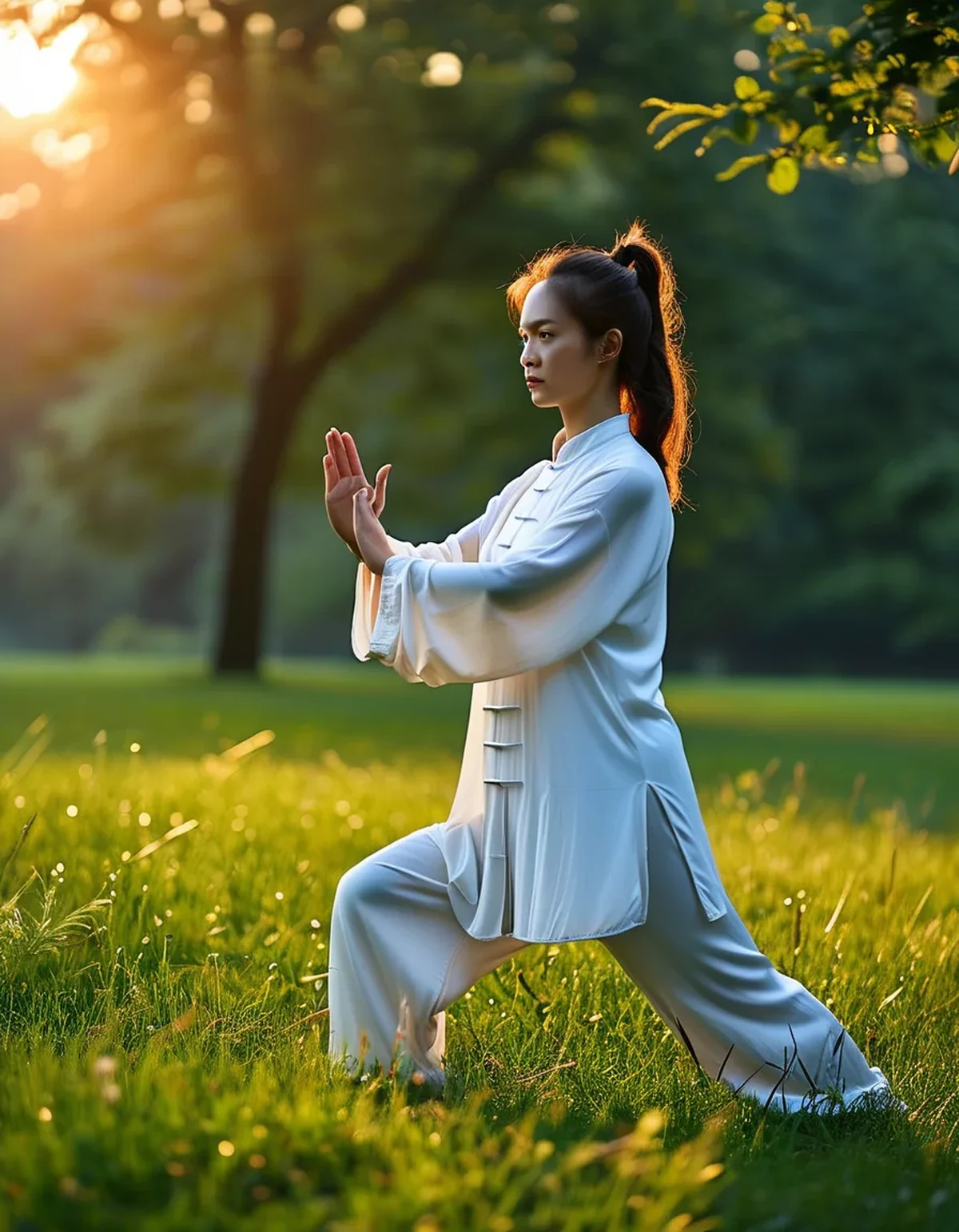
Why does the same form feel unfamiliar outside?
Six reasons, all environmental rather than technical.
The ground is not flat. Grass, gravel and paving all have subtle slopes and inconsistencies. Every weight transfer now includes a small unknown, and tai chi is essentially a sequence of controlled weight transfers.
Your visual reference moves. Indoors, walls, floor lines and mirrors give you a fixed frame. Outdoors, trees move, people walk past, light shifts. Your balance system loses the stable visual anchor it had been quietly relying on.
Depth perception changes in open space. A large open field gives fewer near reference points, and open space genuinely alters how the body orients itself.
Surface compliance varies. Grass compresses under your weight; concrete does not. A soft, uneven surface demands continuous ankle adjustment throughout every transition.
Weather adds load. Wind is an actual force to resist, and a cool breeze changes muscle temperature and joint feel through a session. Neither is present indoors.
And there are no mirrors. Many practitioners rely on mirrors far more than they realise. Removing them exposes how much of the form was visually monitored rather than internally felt — which is uncomfortable and extremely useful information.
Why is that harder version worth practising?
Six benefits that only outdoor practice delivers.
Balance that transfers to real ground. Tai chi has strong evidence behind it for balance and fall prevention, and falls happen on uneven pavements and wet grass, not on studio floors. Practising on the surface that resembles real life is what makes the training transfer.
Better proprioceptive weighting. Being forced off your visual crutch strengthens the joint-position sense that keeps you upright when vision is unreliable — in the dark, on stairs, on a moving bus.
Genuinely deeper attention. Outdoor practice demands continuous adjustment, which produces the focused state people seek from tai chi more reliably than a familiar studio does.
Real vestibular training. Changing head position while your visual field moves is a direct workout for the inner ear system that most indoor practice avoids entirely.
Ankle and foot strength. Continuous micro-adjustments on uneven ground load the small stabilising muscles of the foot and ankle in a way flat floors never do.
And the ordinary reasons. Daylight exposure supports circadian rhythm and sleep, being outdoors is consistently associated with better mood, and morning light in particular is one of the strongest available signals for a stable sleep-wake cycle. This is general information, not medical advice — if you have a balance disorder or recent falls, get professional guidance before practising on uneven ground.
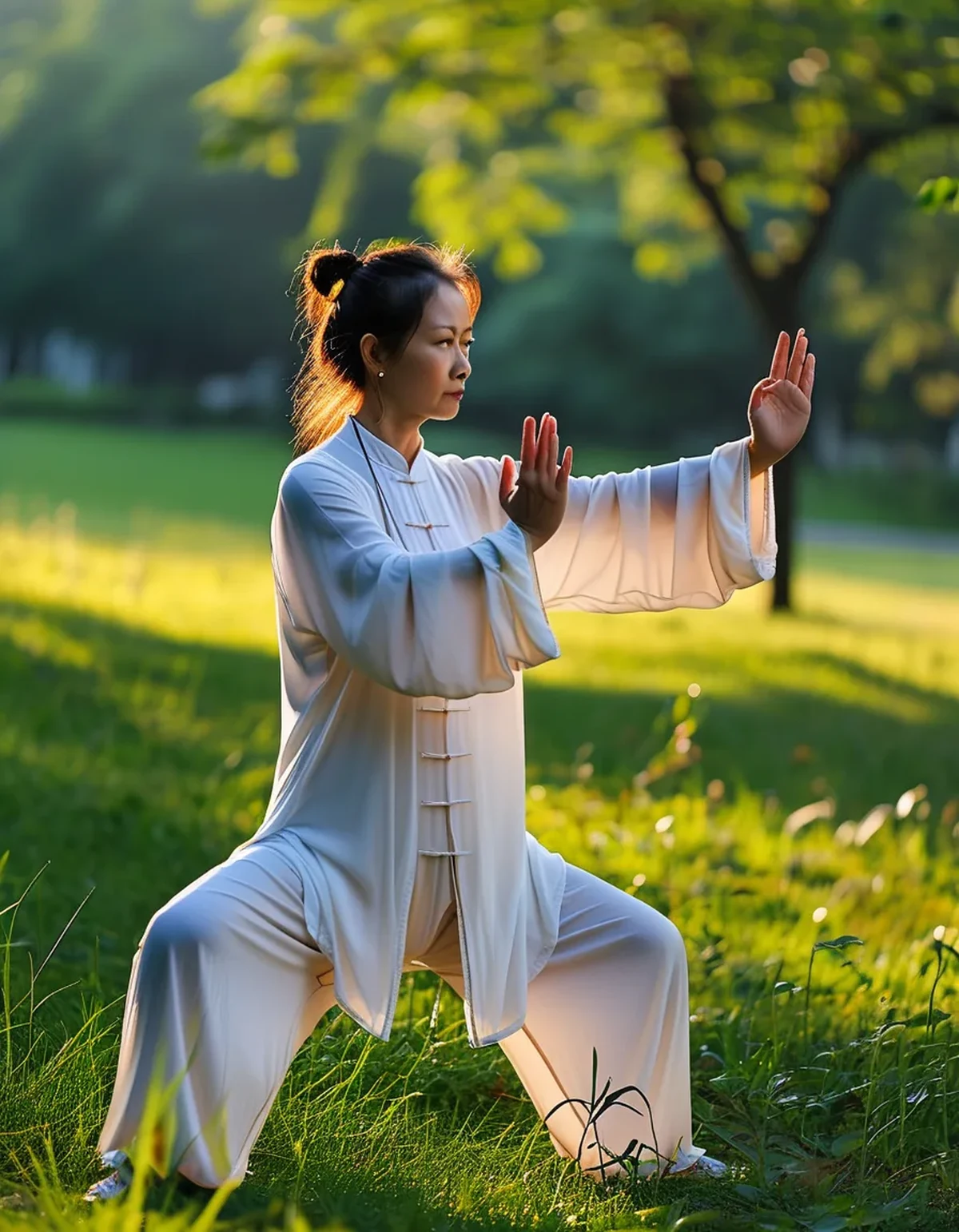
How should you adapt the practice?
Six adjustments that make outdoor practice productive rather than frustrating.
Slow down further than usual. Outdoor practice at indoor speed produces wobbles and frustration. Take roughly 20 to 30 percent longer through each transition and the form becomes practisable immediately.
Shorten your stance width initially. A narrower stance on uneven ground is more manageable while you adapt. Widen it back out over several sessions as the ground stops surprising you.
Pick your surface deliberately, and progress it. Start on a flat lawn or a smooth path, then progress to longer grass, then a gentle slope. Treat surface as a difficulty dial rather than an accident.
Choose footwear consciously. Thin flexible soles give you far more ground information; cushioned trainers insulate you from it. Many practitioners prefer thin-soled shoes outdoors specifically for this reason, though it takes several sessions to adapt.
Practise sections rather than the whole form. Working one sequence repeatedly on uneven ground is more productive than a shaky run-through of the full form.
Use a fixed distant reference point. Choose a specific tree or post and let your gaze return to it in the same way each round. It restores some of the visual stability you lost without putting you back on a mirror.
Seasonal note: early autumn is arguably the best outdoor practice window of the year — comfortable temperatures, softer light, fewer insects than midsummer. Two practical cautions: mornings bring heavy dew, which makes grass genuinely slippery, and falling leaves conceal uneven ground and roots. Walk your practice area once before you start.
Myth vs Fact: Outdoor Tai Chi
Myth: struggling outdoors means your form has regressed. Fact: it means your form was partly supported by a flat floor and a fixed visual field. The struggle is the training effect appearing.
Myth: you need a flat surface to practise properly. Fact: you need a flat surface to practise precisely. Practising on varied ground is what makes the balance transfer to daily life.
Myth: tai chi is too gentle to build strength. Fact: sustained low stances load the quadriceps and hips considerably, and outdoor uneven-ground practice adds meaningful ankle and foot work on top.
Myth: it must be done at dawn. Fact: dawn practice is traditional and pleasant, and there is no evidence any particular time is required. The best time is the one you will keep.
Myth: mirrors are essential for learning form. Fact: mirrors are useful early and become a crutch later. Internal awareness is the actual goal, and outdoors is where you find out how much you have.
Myth: cold weather makes it unsafe. Fact: it makes a longer warm-up necessary. Cold muscles and stiff ankles on uneven ground need an extra 5 to 10 minutes of gentle preparation, and then the practice is fine.
FAQ: Outdoor Tai Chi Questions, Answered
Why do I wobble outside when the form is smooth indoors?
Uneven ground and a moving visual field remove two supports your balance system was quietly using. Your body has to reweight toward proprioception, and that takes several sessions.
Is outdoor practice actually better?
For balance that transfers to real life, yes. For learning precise form, indoors is easier. Most people benefit from doing both.
What surface should I start on?
A flat mown lawn or smooth path. Progress to longer grass and then a gentle slope over several weeks.
What shoes should I wear?
Thin, flexible soles give you the most ground information. Expect a few sessions of adaptation if you normally wear cushioned trainers.
How much slower should I go?
About 20 to 30 percent slower through transitions until the ground stops surprising you.
Where should I look?
Pick a fixed distant reference — a specific tree or post — and return your gaze to it consistently. It replaces some of the visual stability you lost.
Is autumn a good time to start outdoors?
It is one of the best. Watch for dew-slick grass in the mornings and fallen leaves hiding roots — walk the area once before you begin.
TL;DR:
- Balance uses vision, inner ear and proprioception; a studio lets you lean on the first two.
- Outdoors, uneven ground and a moving visual field force a reweighting — that is the training effect.
- Outdoor balance transfers to real life, where falls actually happen.
- Go 20-30 percent slower, narrow your stance at first, and progress surface difficulty deliberately.
- Use thin soles and a fixed distant gaze point, and check the ground for dew and leaves first.
This week, take one familiar section of your form outside onto grass and repeat it slowly for ten minutes. The wobble is the point.
Keep Reading
This article is for general informational purposes only and is not medical advice. Always consult a qualified health professional for guidance specific to you.