Why Tai Chi in Humid Heat Demands a Shorter Form, Not a Slower One
Quick Answer: Tai chi in a low stance is sustained isometric work, and the heat you generate depends on time under load, not on speed. Slowing the form in humid heat keeps you in weight-bearing positions longer while your cooling is already impaired, so core temperature climbs. Shortening the form, or practising a section at your normal tempo, keeps the quality of the movement and reduces the total load. Shorter, not slower.
The slow tempo is the practice. The duration is the variable you should be adjusting.
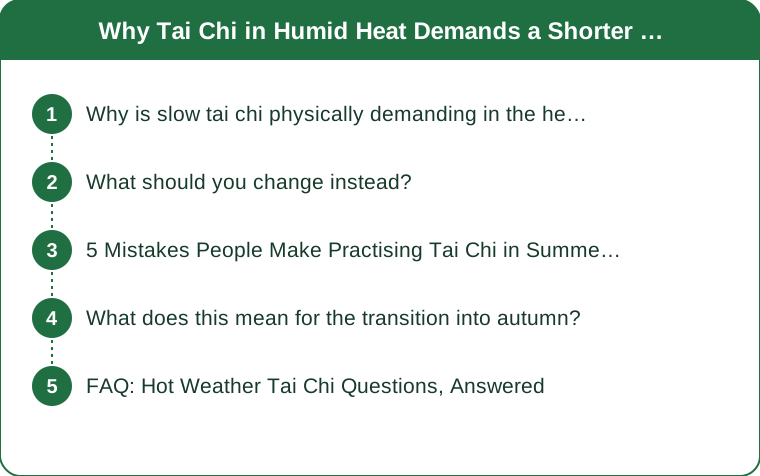
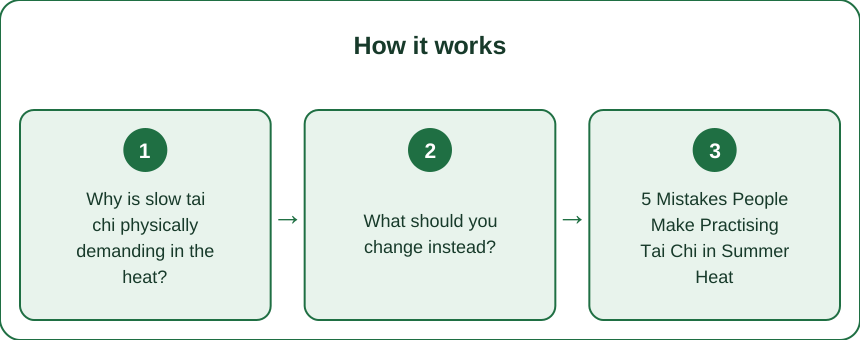
Why is slow tai chi physically demanding in the heat?
Because holding a position costs energy continuously, and heat production scales with time.
Tai chi in a proper low stance is largely isometric. The quadriceps, glutes, and calves are working continuously to hold a position rather than contracting and relaxing rhythmically. Isometric work produces heat without the pumping action that helps circulation move it around.
Sustained muscle contraction also compresses blood vessels within the working muscle, which slightly restricts local blood flow, and blood flow is how heat gets carried away from working tissue toward the skin.
Then the environment intervenes. Your primary cooling mechanism is evaporation of sweat, and evaporation depends on the moisture gradient between skin and air. In humid air that gradient is small, so sweat runs off you without cooling you. You lose the fluid and gain little of the benefit.
The heat load is therefore the product of intensity and duration. In tai chi, intensity is fixed by stance depth, and duration is set by tempo. Slowing the form does not reduce intensity — it increases duration, which is the wrong direction in humid heat.
There is also a postural detail. Long slow forms involve extended single-leg weight bearing, and blood pooling in a stationary standing leg in heat contributes to the light-headedness some practitioners experience.
None of this argues against slow practice, which is the whole method. It argues for adjusting the total exposure rather than the tempo.
What should you change instead?
Length, stance depth, timing of day, and shade. In that order.
Practise a section rather than the whole form. If you normally run a long form, take a third of it and do that at full quality. A shorter form done properly teaches more than a long form done while overheating, and the movement quality is what you are training.
Raise your stance. Stance depth is your intensity dial, and it is entirely under your control. A higher stance in the same form reduces the isometric load substantially while preserving structure, weight transfer, and alignment. Traditional practice varies stance height by conditions and by age, and it is not a compromise.
Move the practice to early morning. Late August mornings are the coolest part of the day and often the calmest, with the lowest air temperature and the least direct sun. Air temperature drops overnight even when humidity stays high, so morning is meaningfully better.
Practise in shade, always. Direct sun adds radiant heat load on top of everything else, and shade under trees is cooler than shade beside a building because of evaporative cooling from foliage.
Increase your rest between repetitions. Rather than running the form continuously, run it, stand and breathe, then run it again. The pauses are where heat dissipates, and dissipation needs time.
Drink before, not just after. Fluid loss in humid conditions is high because sweat runs off rather than evaporating, and thirst lags behind the actual deficit.
Wear less and choose light colours. Loose, light, pale, breathable. Traditional practice clothing is loose for good reason, and loose fabric allows air movement across skin.
Watch the ground surface. Concrete and asphalt radiate stored heat upward for hours after sunset. Grass is genuinely several degrees cooler, and it changes how a long standing practice feels.
5 Mistakes People Make Practising Tai Chi in Summer Heat
1. Slowing down to compensate. The instinct is understandable and the effect is the opposite of what is wanted. Slower means longer under load. Keep your tempo and shorten the session.
2. Practising through light-headedness. Dizziness during a standing practice in heat is a signal, not a phase to push through. Sit down, get in the shade, and drink. Standing still in heat produces blood pooling that a slow form does nothing to counteract.
3. Assuming low intensity means low risk. Tai chi does not feel like hard exercise, which is exactly why people practise for an hour in conditions they would never run in. Heat illness does not require high intensity, only sustained heat production and impaired cooling.
4. Practising on hot hard surfaces. A concrete plaza in late afternoon can be many degrees hotter than adjacent grass, and it radiates upward into a practice performed low to the ground.
5. Not adjusting after a break. Coming back from a holiday or an illness into a humid week at full length is the classic route to a bad session. Acclimatisation fades within one to two weeks, and it needs rebuilding gradually.
What does this mean for the transition into autumn?
The conditions are about to change quickly, and the adjustments run in the opposite direction.
Late August still brings high dew points across much of the United States, and humid air will persist for several more weeks in many regions even as the air temperature eases. Comfortable temperature with high humidity is the condition that catches people out, because it does not feel like a hot day.
Mornings will start cooling noticeably first. Overnight temperatures drop before daytime highs do, and outdoor practitioners will notice the morning session becoming genuinely pleasant within a few weeks.
When it does cool, the adjustments reverse. Cold muscles need a longer warm-up before low stances, and stiffness in the hips and ankles in cool morning air is the main cause of knee complaints in tai chi practice. Extend the warm-up before you extend the form.
Daylight is contracting. Evening outdoor practice will run into dusk sooner each week, and it is worth moving a regular evening session earlier rather than losing it when the light goes.
Autumn is a good time to rebuild the full form. As heat load falls, gradually restore the length and the depth of your stances over a few weeks rather than in one session.
Watch the surface as it changes. Wet grass and fallen leaves become genuinely slippery, and tai chi involves continuous weight transfer, which is precisely the movement that a slippery surface punishes.
This is general practice guidance rather than medical advice. If you have heart disease, blood pressure issues, or take medication affecting fluid balance or heat tolerance, heat and standing practice interact with those, and it is worth a conversation with your doctor about what is appropriate for you.
FAQ: Hot Weather Tai Chi Questions, Answered
Should I practise more slowly in the heat?
No — keep the tempo and shorten the session or raise the stance. Slowing extends the time you spend holding positions, which increases the total heat load rather than reducing it.
How high should I raise my stance?
High enough that you can complete the section without gripping or straining, while keeping alignment and clean weight transfer. Stance height is a legitimate variable in traditional practice, not a shortcut.
Is indoor practice with air conditioning better?
It removes the heat problem, and it also removes the connection to the outdoor practice most people value. A reasonable compromise is early morning outdoors while the season allows, moving indoors as conditions demand.
Why do I feel light-headed during long standing practice?
Usually blood pooling in the legs during sustained standing, made worse by heat-driven vasodilation and by fluid loss. Move, sit, drink, and shorten the standing sections until it resolves.
TL;DR:
- Tai chi in a low stance is isometric work, and heat load scales with duration, so slowing the form makes heat stress worse.
- Shorten the form, raise the stance, practise early, and stay in shade on grass rather than concrete.
- Light-headedness in standing practice is a stop signal, not something to work through.
- As autumn arrives the adjustments reverse: longer warm-ups, gradually restored length, and care on wet ground.
Run a third of your form tomorrow morning at full tempo in the shade. It will teach you more than the whole thing at half speed.
Keep Reading
This article is for general informational purposes only and is not medical advice. Always consult a qualified health professional for guidance specific to you.