Why Tai Chi Forms Fall Apart the Moment You Try to Speed Up
Quick Answer: A tai chi form that falls apart at a faster pace usually reveals transitions between movements that were memorized individually but never truly integrated as a continuous sequence — slow practice can mask this gap, since it gives your mind extra time to consciously recall what comes next.
Your form looks clean and controlled in slow practice, and the moment you try to move at a slightly quicker pace, transitions get muddled or entire movements get skipped. This breakdown isn’t really about speed — it’s revealing which parts of the form you’ve memorized individually rather than learned as one continuous flow.

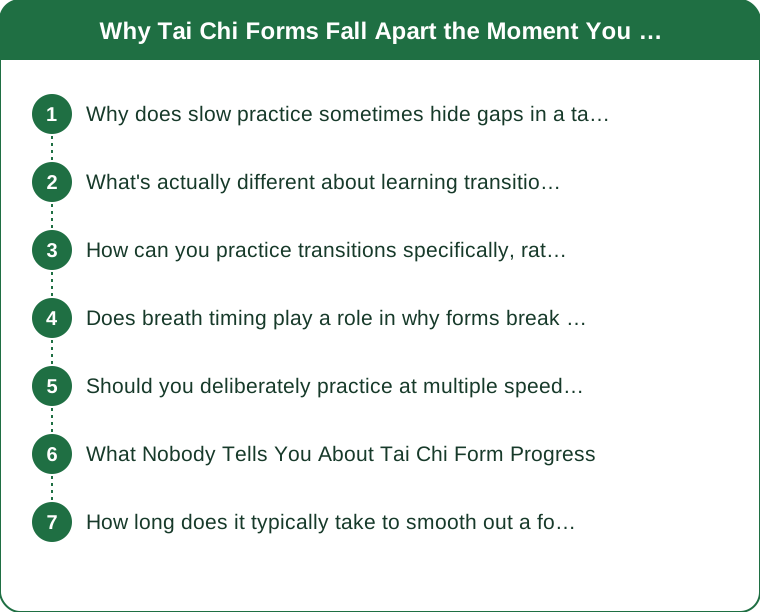
Why does slow practice sometimes hide gaps in a tai chi form?
Moving slowly gives your mind extra processing time to consciously recall the next movement before your body needs to execute it, which can mask genuine gaps in how well the transitions between movements are actually learned. At a faster pace, that extra thinking time disappears, and any movement that was memorized as an isolated step rather than integrated into the flow around it becomes far more likely to break down.
This is a well-recognized pattern among tai chi instructors — slow, technically correct-looking practice doesn’t automatically mean the form is deeply learned, only that it’s been learned at that specific slow pace.
What’s actually different about learning transitions versus learning individual movements?
Individual movements are typically the first thing students learn and practice repeatedly, but the transitions connecting one movement to the next require a separate kind of practice — rehearsing the moment of shifting from one posture into the next, specifically, rather than practicing each posture in isolation. Many students spend far more repetition time on the movements themselves than on these connecting transitions, which is exactly where speed reveals the gap.
How can you practice transitions specifically, rather than whole movements?
Isolate just the transition points — practicing only the last portion of one movement flowing into the first portion of the next, repeated several times, rather than always running the full form from the beginning. This focused transition practice builds the specific connective coordination that whole-form slow practice doesn’t necessarily develop on its own.

Does breath timing play a role in why forms break down at speed?
Yes — tai chi practice typically coordinates breath with movement, and at a faster pace, breath and movement can become desynchronized in a way that contributes to the overall sense of the form ‘falling apart,’ beyond just the physical movement transitions themselves. Practicing breath-movement coordination specifically at a moderate pace, rather than only very slowly, helps this coordination hold up better when speed increases.
Should you deliberately practice at multiple speeds, not just slowly?
Many experienced practitioners and instructors recommend occasionally practicing at a moderately faster pace specifically to reveal these integration gaps, rather than always defaulting to the slowest, most controlled pace. This doesn’t mean abandoning slow practice — it remains valuable for refinement — but adding some faster-paced practice sessions surfaces issues that slow practice alone can hide indefinitely.
What Nobody Tells You About Tai Chi Form Progress
Most students assume smooth slow-pace performance means a form is essentially mastered, but true integration — where transitions flow without conscious step-by-step recall — is really only tested once you remove the extra thinking time that slow practice provides. This is why some students who’ve practiced a form for months still find it falls apart the first time an instructor asks them to try it a bit faster.
This isn’t a discouraging finding — it’s actually useful diagnostic information, pointing directly at which specific transitions need isolated practice rather than more full-form repetition at the same slow pace.
How long does it typically take to smooth out a form at a faster pace once gaps are identified?
Once specific weak transitions are identified and given focused isolated practice, most students notice meaningful improvement within 2-4 weeks of a few minutes of targeted transition practice added to regular sessions. This is much faster than continuing to run the full form slowly and hoping the gaps close on their own through repetition alone.
TL;DR:
- Slow practice can hide gaps in how well transitions between movements are truly learned
- Isolating and repeating just the transition points builds integration that full-form practice misses
- Breath-movement coordination can also desynchronize at a faster pace, adding to the breakdown
- Occasional faster-paced practice reveals these gaps that slow practice alone won’t surface
A form falling apart at speed isn’t a setback — it’s pointing precisely at the transitions worth a few focused minutes of practice this week.
Keep Reading
This article is for general informational purposes only and is not medical advice. Always consult a qualified health professional for guidance specific to you.