Why Tai Chi Feels Easier With Your Eyes Closed — and Why That Matters
Quick Answer: Closing your eyes removes visual competition, which makes the movement feel calmer and more internal. It also removes your most-used balance input, so the fact that you feel steadier is informative: it usually means vision was doing work your proprioception and inner ear should be sharing. Practising short passages with eyes closed trains the other two systems — which is the whole point, because vision is the input that fails first with age and in the dark.
You close your eyes for a few moves and everything suddenly feels smoother and quieter. That is a real effect, and it is telling you something about which system you are relying on.
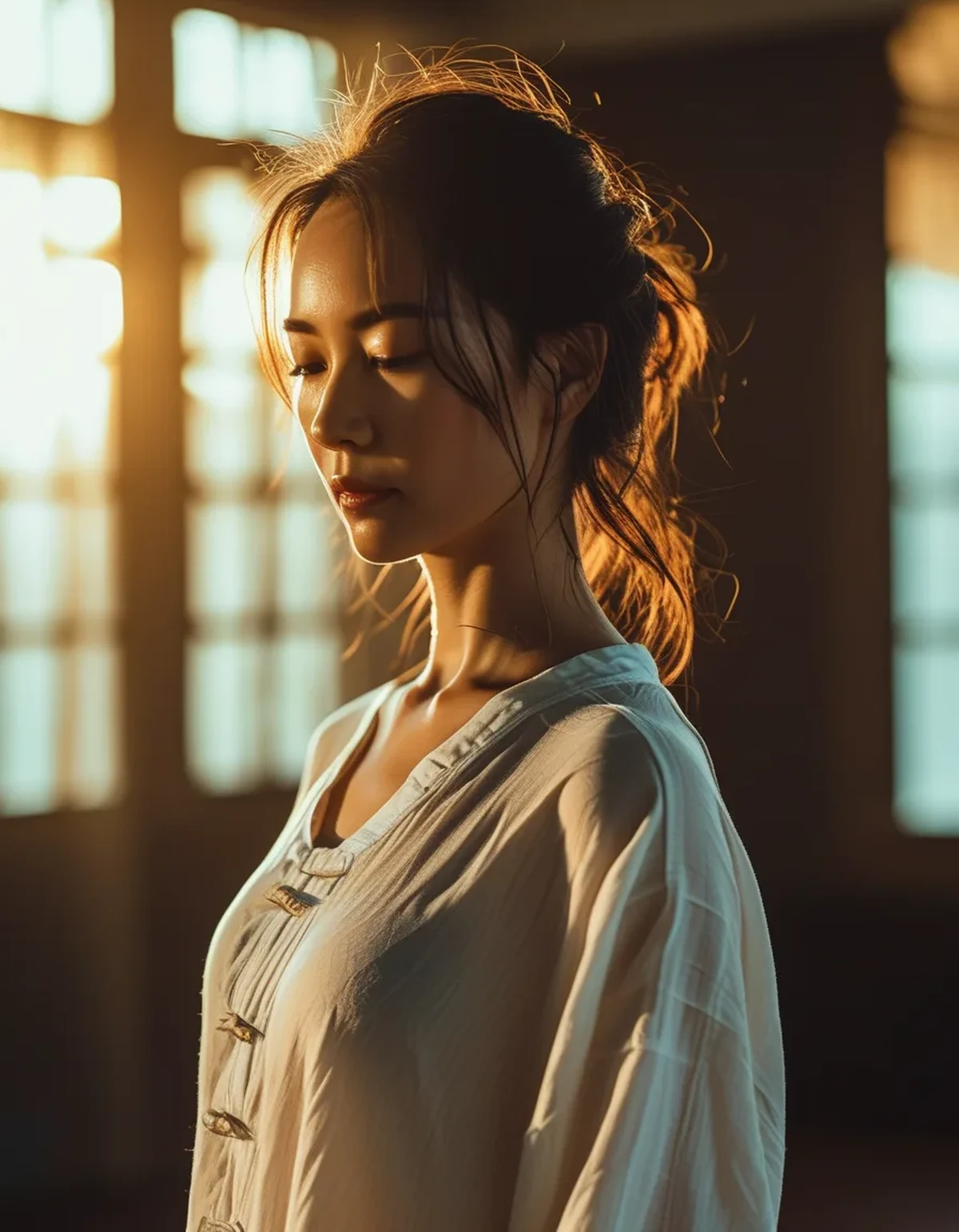
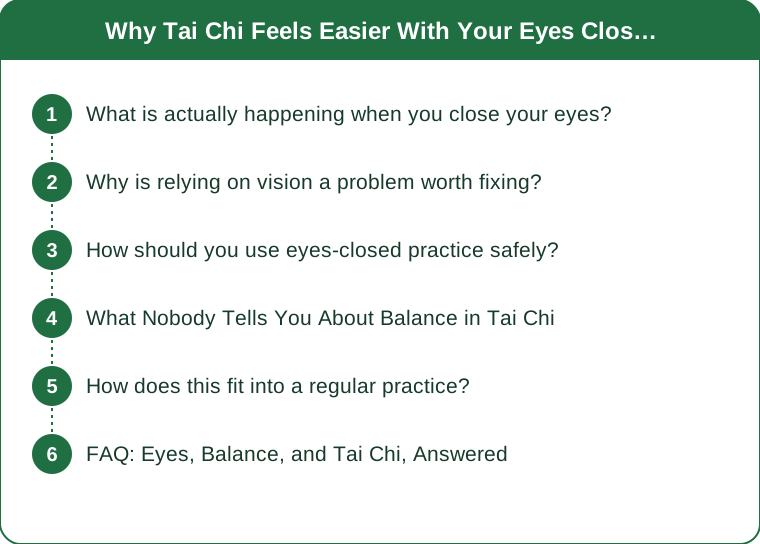
What is actually happening when you close your eyes?
Two separate things, and it is worth telling them apart.
Balance runs on three inputs. Vision tells you where you are relative to the room. The vestibular system in your inner ear tells you about head position and acceleration. Proprioception — sensors in muscles, tendons, and joints, especially in the feet and ankles — tells you where your body parts are relative to each other.
Vision is the dominant input for most adults, and the brain weights it heavily because it is fast and information-rich. Remove it and the brain reweights toward the other two, which is why standing on one leg with eyes closed is dramatically harder than with them open.
So the first thing that happens is that balance gets objectively harder. That is not in question.
The second thing is that attention gets easier, and this is what people are actually noticing. Vision consumes an enormous amount of processing, and in tai chi it also supplies constant self-monitoring — checking your hand position, glancing at a mirror, comparing yourself to the person in front. Closing your eyes removes all of that at once.
What is left is the sensation of your own body, which is precisely the thing tai chi is trying to develop. The form feels smoother because you have stopped watching it and started feeling it.
Both effects are real and they point in opposite directions. Balance is harder; awareness is better. Whether the net feeling is easier depends on which one your practice was short of.
Why is relying on vision a problem worth fixing?
Because it is the input that degrades, and it is unavailable exactly when you need balance most.
Vision fails in the dark. The most common real-world balance challenges — getting up at night, a dim stairwell, a poorly lit street — are all low-vision situations. A balance system that only works in good light is not much of a balance system.
Vision degrades with age, and it does so at the same time as everything else. Contrast sensitivity, depth perception, and the speed of visual processing all decline, which is why balance confidence often drops noticeably in later decades even in people whose legs are perfectly strong.
Vision can also actively mislead. In a moving visual environment — a busy street, a crowd, a bus pulling away beside you — the eyes report motion that the body is not doing, and a vision-dominant balance system responds to it. This is why some people feel unsteady in visually busy places and fine in quiet ones.
Proprioception, by contrast, is highly trainable and it does not depend on light. So does vestibular function, within limits. This is the mechanism behind a good deal of the research interest in tai chi for balance — the practice systematically loads slow weight transfer, single-leg support, and controlled rotation, which are precisely the demands that train the non-visual inputs.
And there is a specific tai chi version of the problem: practising in front of a mirror. A mirror is a powerful visual anchor and it makes balance easier while you are looking at it. It also means the balance you built is partly borrowed from the mirror, and it does not come home with you.
How should you use eyes-closed practice safely?
In small doses, in a safe space, with a specific target — not by closing your eyes for a whole form.
Set the space up first. Stand within arm’s reach of a wall or a sturdy chair back, on a non-slip surface, with nothing on the floor around you. Never practise eyes-closed balance work alone if you have any history of falls, dizziness, or a balance disorder — and if you do have any of those, ask a physiotherapist or doctor what is appropriate before you start. This is general information, not medical advice.
Then progress in this order:
- Standing still, feet parallel, eyes closed. 60 seconds. Notice the small continuous sway — that is your balance system working, and feeling it is the skill.
- Eyes closed, weight shifting side to side, slowly, feet stationary. 10 shifts each way.
- Eyes closed, feet narrower, then in a small forward stance. Same shifting.
- Eyes closed, one short passage of the form — two or three movements only, ones you know completely.
- Eyes closed single-leg, briefly, with a hand hovering near support. This is genuinely difficult and it is where most of the gain is.
Then use the softer version most of the time. Traditional tai chi practice does not call for closed eyes — it calls for a soft, lowered, unfocused gaze, which reduces visual dominance without removing the input entirely. That is the sustainable default, and eyes fully closed is a training tool you dip into.
Two or three minutes of eyes-closed work per session is plenty. It is more demanding than it feels, and fatigue in the ankles and feet comes on faster than you expect.
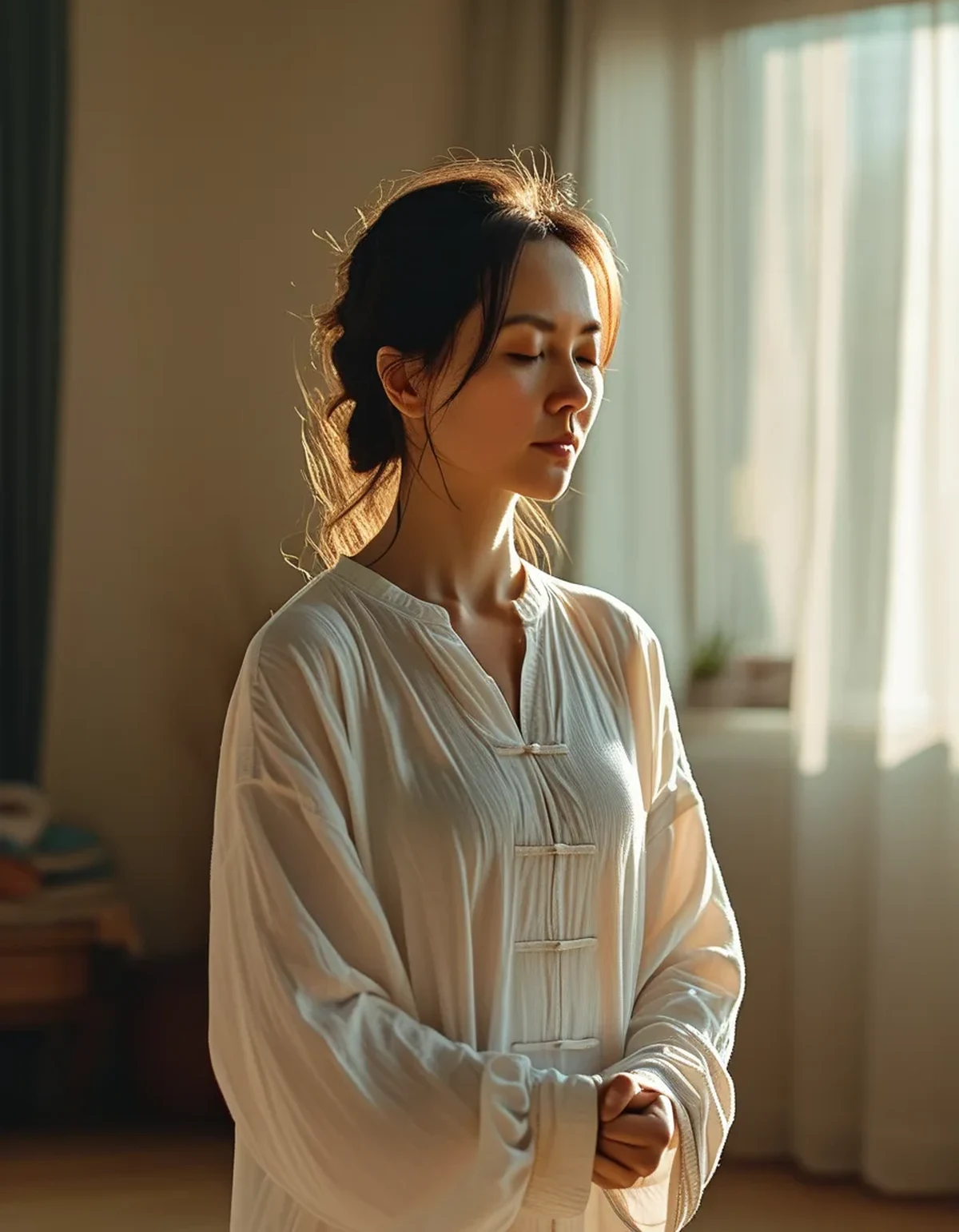
What Nobody Tells You About Balance in Tai Chi
Your feet are the primary sensor, and shoes mute them. Thick, cushioned soles reduce the proprioceptive information reaching your brain from the ground — which is comfortable and it is also insulation from the exact signal you want. Practising barefoot or in thin flat shoes noticeably changes how much you can feel, and most people find their balance improves within a couple of sessions of switching.
Surface changes the difficulty more than the movement does. A hard flat floor is the easy case; grass, sand, or a thick mat is much harder, because the surface itself deforms and the feedback becomes unreliable. This is why the same form feels different outdoors, and it is a free way to progress without changing anything else.
Slow is harder than fast, and that is the design. Moving slowly means spending longer in each single-leg or transitional position, with no momentum to carry you through. Momentum hides balance deficits; slowness exposes them. If a movement feels fine at speed and wobbly slowly, the slow version is telling the truth.
Head position is a vestibular input you control. Turning or tilting the head during a movement changes the signal from your inner ear, which is why the moves that involve looking around are disproportionately hard. Practising those specifically trains the vestibular contribution, and skipping them leaves a gap.
Balance is trainable at any age and it decays quickly without practice. Improvements show up in weeks, which is fast, and they fade over a few weeks of stopping. It behaves much more like a skill than like strength.
And the sway is not the problem. Beginners often try to eliminate all movement and end up rigid, which is worse. A balanced body sways continuously and corrects continuously — the goal is small, soft, early corrections, not stillness.
How does this fit into a regular practice?
As a small deliberate component, with the rest of the session unchanged.
Keep the soft gaze as your normal practice. Eyes open, gaze lowered to a point a few feet ahead on the floor, focus soft rather than fixed. This is what the tradition asks for and it already reduces visual dominance considerably compared to scanning the room or watching yourself.
Add two to three minutes of eyes-closed work, ideally at the start of a session when you are freshest, or at the end as a settling practice. Not in the middle of a form — the transitions in and out are where people wobble most.
Give up the mirror gradually. If you learn from a mirror, run the same passage once facing the mirror and once facing away, and treat the away version as the real one. Most people find a noticeable difference, which is the whole point.
Vary the surface across the week. One session on a firm floor, one on grass or a mat if you can. The variation trains adaptability rather than a single condition.
Track something concrete. Time a single-leg stand with eyes open and again with eyes closed, once a fortnight. The ratio between the two numbers is a rough read on how vision-dependent you are, and watching that ratio improve is far more motivating than a vague sense of steadiness.
And bring it outside while you can. As the season turns, practice moves indoors for most people and daylight gets shorter at both ends — which means less varied surface, more artificial light, and often a mirror. Worth deliberately keeping some outdoor or eyes-closed work in the routine over the coming months, precisely because the rest of the environment is getting more visually uniform.
One caution to repeat, because it matters: if you get dizzy, nauseous, or genuinely unsteady with eyes closed rather than just challenged, stop and mention it to a doctor. Vertigo and vestibular problems are common, treatable, and not something to train through.
FAQ: Eyes, Balance, and Tai Chi, Answered
Should I practise the whole form with my eyes closed?
No. It removes the safety margin, and the transitions between movements are where balance is most challenged, so a full form eyes-closed is a lot of risk for little extra benefit. Two or three movements you know thoroughly, near a wall, is the useful dose.
Is a soft gaze the same thing as closing your eyes?
Not the same, and it is the sustainable version. A lowered unfocused gaze reduces how much you are visually self-monitoring while keeping the visual reference for orientation. Most of the internal-awareness benefit people notice from closing their eyes is available from a genuinely soft gaze, without the balance risk.
Why do I sway more when I try to stand perfectly still?
Because trying to eliminate sway makes you stiffen, and a stiff body cannot make the small early corrections that balance depends on — so the corrections arrive late and large. Soft knees, relaxed ankles, breathing out, and accepting continuous small movement produces far more stability than holding yourself rigid does.
TL;DR:
- Closing your eyes removes visual self-monitoring, which is why the form feels smoother and more internal
- It also removes your dominant balance input, so feeling steadier is a sign vision was doing too much of the work
- Vision is the input that fails in the dark and degrades with age, and proprioception is the one that trains well
- Use two to three minutes of eyes-closed work near a wall, keep a soft lowered gaze as your default, and give up the mirror gradually
- Thin shoes, varied surfaces, and slow tempo all raise the training effect; dizziness rather than difficulty means stop and ask a doctor
The easier feeling is worth paying attention to precisely because it is a diagnosis. Take vision out for two minutes at a time, and the balance you build is the kind that still works when the lights are off.
Keep Reading
This article is for general informational purposes only and is not medical advice. Always consult a qualified health professional for guidance specific to you.