Why Tai Chi Feels Different When You Practise at the Same Time Every Day
Quick Answer: Joint stiffness peaks after a night of stillness, balance tends to be sharpest in the afternoon, and body temperature - which affects tissue flexibility - follows a daily curve peaking in the late afternoon. Morning practice therefore feels stiffer and more effortful, and evening practice feels smoother but is less useful for setting up the day. Neither is better. Pick one and keep it, because consistency at one time beats variety across several.
The form did not change overnight.
Your body did, and it does the same thing every day.
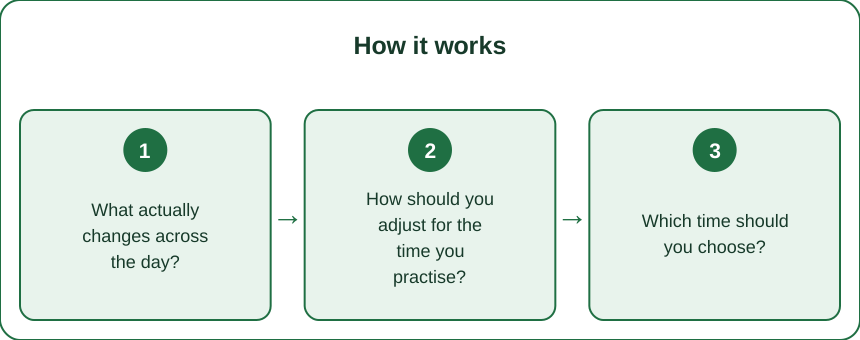
What actually changes across the day?
Three separate systems, each on its own cycle.
Joint stiffness is highest on waking. Synovial fluid distributes with movement, and a night of stillness leaves joints less lubricated. The first twenty minutes of the day is the stiffest you will be, which is precisely when many people practise.
Body temperature follows a clear daily curve. It is lowest in the early hours and peaks in the late afternoon or early evening, and warmer tissue is more compliant. Late afternoon is when your range of motion is genuinely greatest.
Balance tends to be better later in the day. Reaction time and postural control both improve from morning through afternoon in most people. A weight shift that feels precarious at 7am often feels solid at 5pm.
And your nervous system state differs entirely. Morning practice meets a system that is ramping up; evening practice meets one that is winding down. The same slow form does something different depending on which it meets - which is why morning practice feels activating and evening practice feels settling.
None of this makes one time correct. It makes the two times different tools. The mistake is expecting them to feel the same and concluding your practice has regressed.
How should you adjust for the time you practise?
Change the warm-up and the expectation, not the form.
Morning practice needs a longer warm-up. Five to ten minutes of joint circles, gentle weight shifts, and slow arm movements before the form. Skipping this is why morning practice feels laboured and why knees complain.
Reduce the stance depth in the morning. A higher stance with cold joints is not a compromise - it is the correct choice. Depth can increase as the session progresses.
Expect less range and do not chase it. Reaching for your afternoon range on a cold morning is where strain comes from. The form is the same; the amplitude is smaller.
Evening practice can go deeper and slower. Warmer tissue and better balance mean lower stances and longer holds are available. This is the session to work on precision rather than to fight for it.
Late evening needs a gentler ending. A vigorous form close to bedtime can be activating for some people. Finish with standing meditation or slow breathing if you practise late.
And keep the time fixed. The adaptation to a consistent time is real - practise at 7am daily and your 7am body gradually becomes better at it. Moving the session around means never getting that adaptation.

Which time should you choose?
The one you will actually do, weighted by what you want from it.
Morning if you want the day-setting effect. Practice before the day starts is far less likely to be displaced by events, and the calming effect carries forward for hours. Consistency is highest in the morning for almost everyone.
Late afternoon if you want the best physical quality. Warmest tissue, best balance, best coordination. If you are working on a difficult transition, this is when to work on it.
Evening if you want the wind-down. Slow movement and breath work in the evening is genuinely effective at shifting a nervous system out of a busy day. Many people sleep better for it.
Split it if you can. A short morning session for mobility and a longer evening one for depth. Ten minutes and thirty minutes beats forty in one block, for most purposes.
And judge the choice over weeks, not days. Any new time feels wrong for the first week. Give a time slot a month before deciding it does not suit you.
In late summer, early morning is unusually pleasant - cool, still, and light early. This is the easiest few weeks of the year to establish a morning habit, and it is worth using before the mornings get dark. If you have a joint condition or persistent pain that changes across the day, that pattern is worth mentioning to a physio. This is general information, not medical advice.
What Nobody Tells You About Practice Timing
The stiff morning session is doing something the smooth evening one is not. Moving through restricted range distributes synovial fluid and is exactly what stiff joints need. The session that feels worst is often the one with the most benefit for joint health.
Consistency beats optimisation by a wide margin. A daily practice at a mediocre time produces far more than an occasional practice at the perfect time. The best time is the one that survives a busy week.
Your form will look different at different times, and that is normal. Filming yourself morning and evening is an interesting exercise - the difference in stance depth and fluidity surprises most people.
Seasonal light will move your slot for you. A morning practice established in August becomes a dark morning practice in November. Decide now whether it moves indoors or moves later - people who do not decide simply stop.
Practising in the same place matters as much as the same time. The cue is contextual as much as temporal. Same corner of the same room at the same hour is the strongest habit structure available.
And the days you least want to practise are the informative ones. A ten-minute session on a bad day maintains the habit and usually feels better than expected. The rule that works is never zero, not never less than thirty minutes.
FAQ: Practice Timing, Answered
Is morning tai chi actually traditional?
Dawn practice has a long tradition, and there are good practical reasons for it - cool air, quiet, and a clear slot before the day intervenes. The tradition is about consistency and conditions, not a claim that the body works better at dawn.
Can I practise right after eating?
Better to wait. Slow movement after a large meal is not harmful, but most people find the deep breathing and the trunk rotation uncomfortable. Thirty to sixty minutes after a normal meal is usually enough.
Does practising twice a day help?
Yes, if the sessions have different purposes - a short mobility session in the morning and a longer form in the evening. Two identical sessions produce less than one plus a rest day, particularly for balance work, which benefits from consolidation.
TL;DR:
- Joints are stiffest on waking, tissue warmest in the late afternoon, balance best later in the day.
- Morning practice needs a longer warm-up and a higher stance - reduce amplitude, not the form.
- Late afternoon is the best physical quality; evening is the best wind-down.
- Consistency at one time beats variety - your body adapts to the slot you keep.
- Decide now what happens when the mornings get dark, or the habit ends in November.
Pick your slot this week and put it in the calendar as a fixed appointment. The time you choose matters far less than not moving it.
Keep Reading
This article is for general informational purposes only and is not medical advice. Always consult a qualified health professional for guidance specific to you.