Why Your Tai Chi Form Looks Right But Still Feels Stiff
Quick Answer: Tension held in the wrists and fingers is one of the most common, least-noticed reasons a technically correct tai chi form still looks and feels stiff — relaxed, slightly curved hands let the rest of the arm and shoulder soften in response, while clenched or overly flat hands keep the whole limb subtly braced.
You’ve drilled the sequence enough that your feet and hips know where to go. But watching yourself on video, the movement still looks tight rather than flowing, and you can’t quite place why.

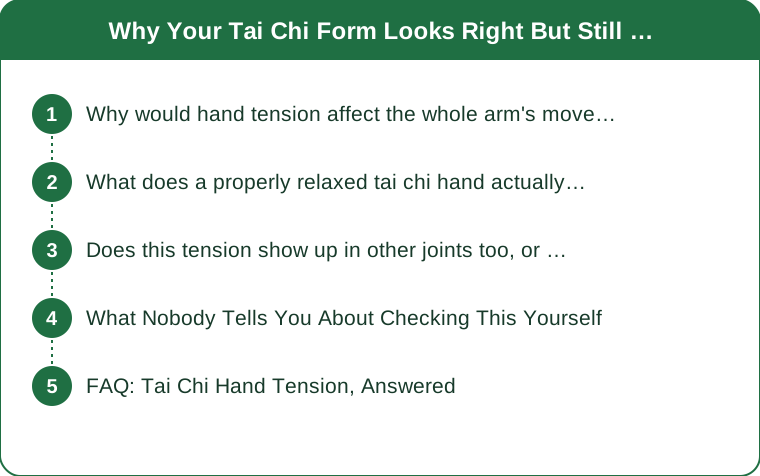
Why would hand tension affect the whole arm’s movement quality?
The hands and wrists sit at the very end of the kinetic chain, and tension there tends to travel backward up through the forearm, elbow, and shoulder. A clenched fist or a rigid, flat palm keeps small stabilizing muscles engaged that should be resting, which shows up as a subtly jerky or mechanical quality even when the larger arm movement is technically correct.
What does a properly relaxed tai chi hand actually look like?
Most traditional guidance describes a softly curved hand — fingers gently separated and slightly bent, not flat and rigid, not loosely dangling either. This middle position allows energy, and simply muscular relaxation, to flow through without the hand collapsing or bracing, and it’s a specific shape worth checking in a mirror rather than assuming by feel.

Does this tension show up in other joints too, or is it mainly the hands?
Hand and wrist tension is one of the most common starting points, but the same pattern often appears in the jaw, shoulders, and even the toes. Many instructors deliberately check hands first because it’s the most visible and easiest joint for a beginner to consciously soften, and doing so often triggers a noticeable relaxation cascade through the rest of the body.
What Nobody Tells You About Checking This Yourself
Here’s a simple self-check most people never try: pause mid-form and look down at your hand shape without changing anything. If your fingers are pressed tightly together or your palm is rigidly flat, that’s very likely tension you didn’t know was there, carried over from daily habits like typing or gripping a phone.
FAQ: Tai Chi Hand Tension, Answered
Should I consciously think about my hands the whole time I practice?
Not the whole time — checking in once or twice per form is enough to build the habit without pulling focus from the rest of the movement.
Does this apply to standing meditation (zhan zhuang) too, not just moving forms?
Yes, arguably even more so, since standing practice gives you more time to notice and correct held tension without the distraction of transitioning between postures.
Can shoes or floor surface affect how much tension carries up into the hands?
Indirectly — if your feet or legs are working harder to stabilize on an unstable or slippery surface, that extra effort can translate into more general body tension, including in the hands.
TL;DR:
- Wrist and hand tension is a common, overlooked cause of a stiff-looking tai chi form
- A softly curved hand shape (not flat, not dangling) allows tension to release through the whole arm
- The same tension pattern often shows up in the jaw and shoulders too
- Checking hand shape mid-form is a quick, practical way to catch it
Next practice, pause once mid-form just to check your hand shape — that single adjustment often changes how the whole movement feels, not just looks.
Keep Reading
This article is for general informational purposes only and is not medical advice. Always consult a qualified health professional for guidance specific to you.