How to Adjust Your Tai Chi Practice for Cold Mornings
Quick Answer: Cold tissue is genuinely less compliant — muscle and fascia are stiffer, joint fluid is more viscous, and your usable range of motion drops before you have done anything wrong. Warm up longer, start higher in your stance, and let depth arrive during the form rather than demanding it at the start. Ten minutes of gentle preparation restores most of what the cold took, and forcing depth on cold joints is how autumn knee pain begins.
You have done this form hundreds of times. This morning it feels like someone rearranged it.
Your stance will not settle, the weight shifts feel abrupt, and there is a small complaint in the front knee that was not there in August. Nothing about your practice has degraded — the tissue you are practicing with is a few degrees colder, and that is enough to change everything. The third section covers the adjustment that matters most for your knees.
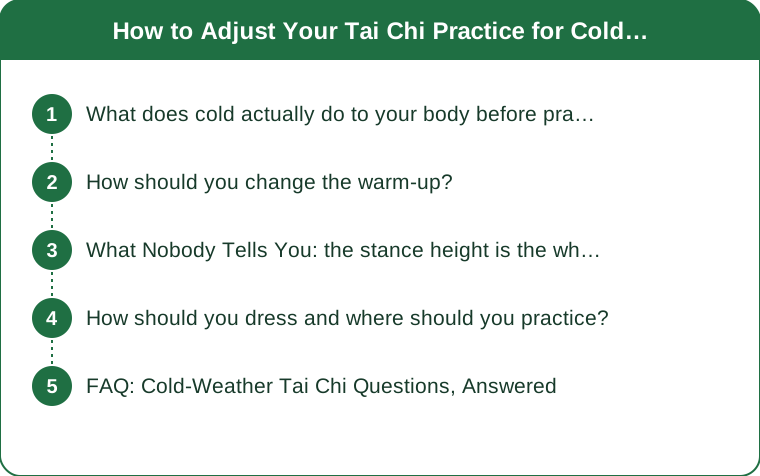
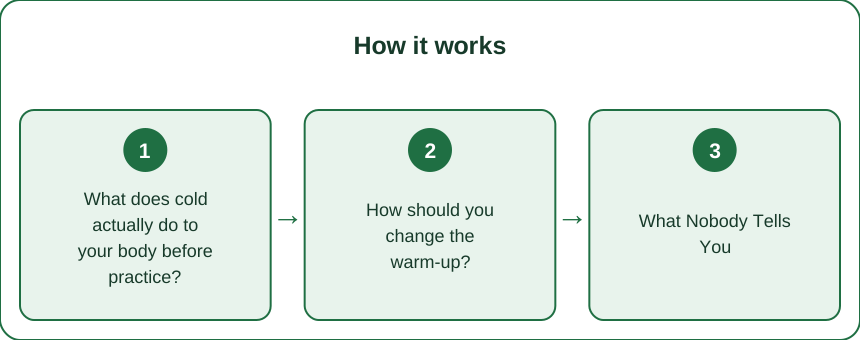
What does cold actually do to your body before practice?
Several things happen simultaneously, and they compound.
Muscle and connective tissue become stiffer. Their mechanical properties are temperature dependent — colder tissue resists lengthening more and returns to shape more slowly. Your hamstrings and hip flexors are genuinely less extensible at 45°F than at 75°F, before any question of flexibility training arises.
Synovial fluid thickens. The fluid lubricating your joints is more viscous when cold, which is the physical basis for the stiff, gritty feeling in knees and hips in the first minutes of a cold morning.
Peripheral circulation drops. Your body preserves core temperature by constricting blood vessels in the extremities. Less blood to hands and feet means colder tissue and reduced fine control — relevant in a practice built on precise weight distribution and open, relaxed hands.
Proprioception dulls slightly. Your sense of where your body is in space is somewhat less sharp when cold, which directly affects the balance component of the form.
You brace without noticing. Cold air causes a subtle protective tightening — shoulders drawn up, jaw set, breathing shallower and higher in the chest. All three are exactly opposed to what the practice asks for.
That last one is the most important. Half of what feels wrong in a cold-morning form is not stiffness, it is bracing — and bracing responds to attention much faster than stiffness responds to time.
How should you change the warm-up?
Longer, and different in kind. In summer, five minutes of standing and breathing was enough. In autumn, aim for ten to fifteen and make it active.
Start indoors if you can. Even five minutes of movement in a warm room before going out changes the whole session. Raising core temperature is the goal, not stretching.
Move rather than stretch. Static stretching of cold tissue is not the useful intervention and can be counterproductive. Instead:
Gentle joint rotations, from the top down. Neck turns, shoulder circles, elbow and wrist circles, waist turns, hip circles, knee circles, ankle rolls. Small at first, growing. Two or three minutes.
Weight-shifting practice. Stand in a comfortable stance and shift slowly side to side and front to back, no form, no arms. This warms exactly the tissue the form loads and rehearses the fundamental skill of the practice at zero risk.
Arm swinging and light patting. Traditional warm-ups include swinging the arms across the body and lightly patting the limbs. Both raise surface circulation and both are more useful in cold weather than they seem in warm.
Rise onto the toes and settle, several times. Warms the calves and ankles, which is where cold most limits your ability to sink into a stance.
Then run the form once at a higher stance than usual, as the real warm-up. The first repetition is preparation, not performance.
What Nobody Tells You: the stance height is the whole adjustment
If you take one thing from this article, it is this: raise your stance in cold weather, deliberately and without guilt.
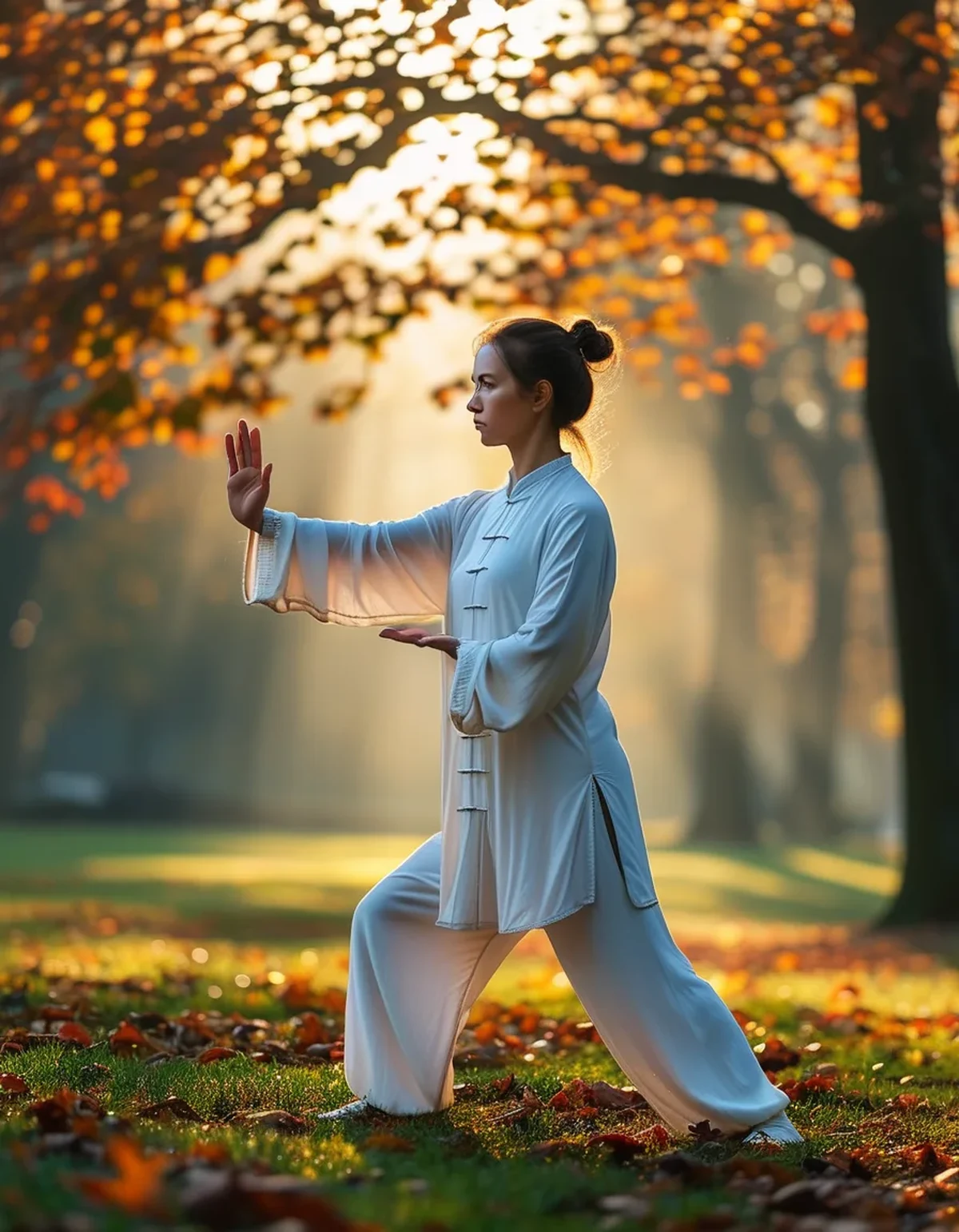
Tai chi stances load the front knee substantially, and how much depends on how low you sit. In a warm body with warm tissue and good circulation, a low stance is a strength-building position. In a cold body, the same position asks the joint to work through a stiffer, less lubricated range while the muscles supporting it are producing less force.
This is where autumn knee complaints come from — not from doing anything new, but from doing the exact same thing in a body that is temporarily less prepared for it.
The adjustment is simple and it is not a compromise. Start noticeably higher than your summer stance. Let the depth arrive on its own as you warm through the form. By the second or third repetition you will often find your usual depth returns without your having decided to go there. That is what you want — depth as a result, not an entry requirement.
The related cue: keep the knee tracking over the foot, and never past the toes. Cold, distracted practice is when alignment slips, and misalignment plus load is the mechanism behind most practice-related knee pain.
There is a philosophical point buried here that regular practitioners tend to appreciate. The form is supposed to respond to conditions. Practicing the identical shape in every season is not consistency — it is inattention. Adjusting for a cold morning is the practice working exactly as intended.
If knee pain persists beyond a session, is sharp rather than achy, or changes how you walk, stop and see a professional. This is general information, not medical advice.
How should you dress and where should you practice?
Small logistics that make the difference between a practice you keep and one that quietly stops in November.
Layer, and plan to remove one. You will warm up during the form. Start with a light removable layer over a base you can practice in comfortably. Wearing your warmest coat throughout means restricted shoulders and no benefit.
Loose at the joints, warm at the core. Nothing binding at the knees, hips, or shoulders. A warm vest is often better than a jacket, because it keeps your torso warm without restricting arm movement.
Feet are the priority. Cold feet destroy the rooting and sensitivity the practice depends on. Warmer socks and shoes with a flexible sole that still lets you feel the ground. Thick rigid winter boots defeat the purpose.
Hands need attention. Cold, stiff hands cannot open and relax, which changes the quality of every movement. Thin gloves are entirely reasonable, and rubbing the hands together before starting is a genuinely traditional and genuinely effective move.
Choose your spot for wind, not just space. Wind is the dominant factor in how cold you feel while moving slowly. Practicing beside a wall, hedge, or building on the sheltered side is worth more than a bigger open area.
Consider the time. Mid-morning, once the sun has been up a while, is dramatically more comfortable than dawn in autumn and costs you little. If the dawn practice is important to you, do the first repetition indoors and go out for the second.
Have a plan for genuinely bad days. A form done indoors in a small space at a higher stance is far better than a form skipped. Consistency across the season matters more than any individual session’s conditions.
FAQ: Cold-Weather Tai Chi Questions, Answered
Is it bad to practice outdoors in cold weather?
No — outdoor practice in cool weather is a long-standing tradition and there is nothing harmful about it, provided you warm up properly and dress sensibly. What causes problems is treating a cold body like a warm one, not the cold itself.
Why do my knees ache after practice now but not in summer?
Most likely a combination of insufficient warm-up, a stance that is too low for cold tissue, and alignment slipping when you are distracted by the cold. Raise the stance, extend the warm-up, and check knee-over-foot tracking. If it persists, get it looked at.
Should I practice faster to stay warm?
No. Speeding up the form defeats its purpose and does not warm you efficiently. Do a longer active warm-up before you begin, add a layer, and keep the form at its proper tempo.
TL;DR:
- Cold tissue is genuinely stiffer and joint fluid more viscous — your range drops before you do anything wrong.
- Warm up ten to fifteen minutes with movement, not static stretching.
- Raise your stance and let depth arrive during the form; forcing it cold is how knees get sore.
- Prioritize warm feet and hands, shelter from wind, and practice mid-morning if you can.
- Adjusting the form for conditions is the practice working, not a compromise.
There is a particular satisfaction to keeping a practice going into the cold months, and it has less to do with discipline than with adjustment. The practitioners who are still out there in January are not tougher — they are the ones who stopped demanding that October behave like July. Give yourself the longer warm-up, take the higher stance for the first repetition, put on the extra pair of socks, and the form will meet you where you are. That, in the end, is what the whole thing is supposed to teach.
Keep Reading
This article is for general informational purposes only and is not medical advice. Always consult a qualified health professional for guidance specific to you.